FLASHBACK: INT. CHILDHOOD HOME - NIGHT - 33 YEARS EARLIER
The memory comes without warning, carried on waves of exhaustion and relief.
Twelve-year-old John Harrison sits outside his brother’s bedroom door, listening to sounds he doesn’t understand. Adult voices, hushed and urgent. Medical equipment beeping. His mother crying.
David is sick. Has been sick for three days. The doctors say it’s meningitis. A word John had to look up in the encyclopedia. It means the lining around David’s brain is infected. It means everything is wrong.
The door opens. John’s father emerges, face gray with exhaustion, eyes red from tears he won’t let fall.
“Dad?”
His father kneels, brings himself to John’s level. “Johnny. I need you to be brave now. Can you do that?”
“Is David going to be okay?”
A pause. A terrible, endless pause.
“The doctors did everything they could.” His father’s voice cracks. “Sometimes that’s not enough.”
John doesn’t understand. David was fine a week ago. They were playing baseball. David hit a home run. They were planning to build a treehouse this summer.
“I don’t…” John’s voice breaks. “I don’t understand.”
His father pulls him close. “Neither do I, son. Neither do I.”
Later, hours or days, John loses track, he sits in the hospital chapel while his parents make arrangements he can’t bear to think about. A doctor finds him there. Young. Tired. Kind eyes.
“You’re John? David’s brother?”
John nods.
The doctor sits beside him. “I’m Dr. Reeves. I worked on your brother’s case.”
“You couldn’t save him.”
“No.” Dr. Reeves doesn’t make excuses. “We couldn’t. By the time we recognized the symptoms, the infection had spread too far.”
“Why?” The question tears out of John. “Why couldn’t you recognize it sooner?”
“Because medicine isn’t perfect. Because we don’t always know what we’re looking at until it’s too late.” Dr. Reeves is still for a moment. “But that’s changing. Every patient we lose teaches us. Every failure pushes us to do better.”
“That doesn’t help David.”
“No. It doesn’t.” Dr. Reeves meets his eyes. “But it might help the next David. And the one after that. And the one after that.” He leans forward. “That’s why I became a doctor, John. Not because I could save everyone. I knew I couldn’t. But because every person I do save is worth the ones I couldn’t.”
John thinks about this for a long time. About David. About the next David. About all the Davids in all the hospitals in all the world.
“I want to do that,” he says. “I want to save people.”
Dr. Reeves smiles. Sad. Tired. But genuine. “Then you will. The wanting is what matters.”
INT. MAINLAND HOSPITAL - EMERGENCY FACILITY - 36 HOURS LATER
John’s hands were steady as he worked.
They’d reached the mainland just as dawn broke, guided by Carlos to a small fishing village with a medical clinic. From there, emergency services, finally mobilized, days too late, had transported them to a proper hospital.
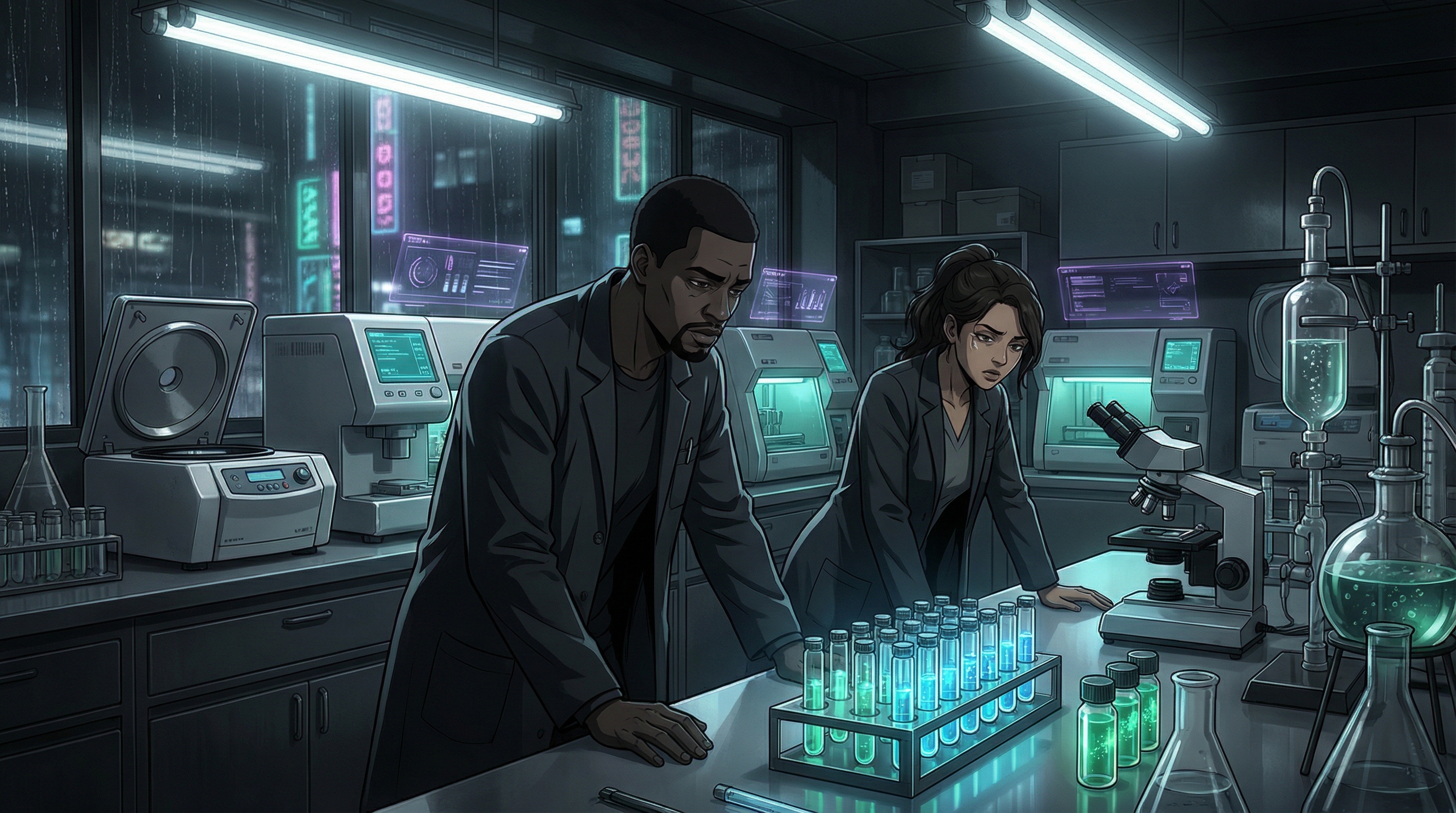
Elena had taken over a section of the lab, her CDC credentials smoothing the way. John assisted, his viral knowledge combining with her engineering expertise. The samples they’d recovered were pure. Stage 4 neural tissue. Exactly what Elena needed.
“The fungal component has a specific receptor,” Elena explained, her hands moving through the synthesis process with practiced precision. “It’s what allows the infection to hijack neural pathways. If we can create a compound that binds to that receptor first…”
“We block the infection.” John understood. “It can’t take hold if there’s nowhere to attach.”
“Exactly. And for those already infected, early stages at least, the blocking compound should disrupt the existing bonds. Force the fungal tissue to release its hold.”
“A cure.”
“A treatment.” Elena’s smile was bitter. “Stage 3 and beyond, the neural damage is too extensive. There’s no coming back from that.”
“But we can stop it from spreading. Stop new infections.”
“If we can synthesize enough. If we can distribute it in time.” Elena looked at him. “And if we can stop the people who created this from releasing it elsewhere.”
John thought about Mark’s files. The coordinates. Six other facilities.
“One thing at a time.”
INT. MAINLAND HOSPITAL - PATIENT WARD - LATER
Lisa sat beside her children’s beds, watching them sleep.
They’d been treated for minor injuries, given fluids and sedatives, told to rest. Sarah had fallen asleep mid-sentence, her body surrendering to the exhaustion she’d been fighting for days. Michael had held on longer, asking questions about zombie viral mechanisms until the medication pulled him under.
Her children. Her impossible, brave, broken children.
“Hey.” John appeared in the doorway, looking more dead than alive. “How are they?”
“Sleeping. At last.” Lisa patted the chair beside her. “Sit. You look like you’re about to collapse.”
John sat. They watched their children breathe.
“I keep thinking about what could have happened,” Lisa said quietly. “All the ways we could have lost them.”
“But we didn’t.”
“No. We didn’t.” She took his hand. “Because of you. Because you wouldn’t give up.”
“Because of us. All of us.” John’s grip on her hand didn’t loosen. “I couldn’t have done this alone. Any of it.”
“No.” Lisa’s smile was tired but real. “That’s the point, isn’t it? We’re stronger together.”
John thought about David. About Dr. Reeves. About thirty years of fighting to save people, failing more often than succeeding, carrying the weight of every life he couldn’t reach.
“I became a scientist because I thought I could save everyone,” he said. “But that was never the point. The point is saving who you can, when you can, with whatever you have.”
“And you have us.”
“I have you.” John leaned over, kissed her forehead. “That’s enough. That’s more than enough.”
INT. MAINLAND HOSPITAL - LABORATORY - NIGHT
The synthesis was complete.
Elena held up a vial of clear liquid. Small. Unassuming. The product of forty hours of work and three days of nightmare.
“Eden-1 Antiviral,” she said. “Not the catchiest name.”
“We can workshop it later.” John took the vial, examined it against the light. “This will work?”
“Theory says yes. Animal trials say yes. Human trials…” She shrugged. “We’re about to find out.”
They’d identified an early-stage patient. A resort worker who’d been evacuated before full transformation. The infection had taken hold, but he was still conscious. Still human. Still salvageable.
“If this works,” John said, “we can stop the outbreak. Protect the mainland. Prevent what happened at Eden from happening anywhere else.”
“And if it doesn’t?”
“Then we try again. And again. Until we get it right or we run out of time.”
Elena smiled. The first genuine smile John had seen from her. “You really are an optimist.”
“I’m a father.” John handed the vial back. “Optimism is a job requirement.”
They walked toward the isolation ward together. Elena would administer the treatment. John would monitor the response. And somewhere, in a hospital room three floors up, his family would sleep peacefully for the first time in days.
The cure had to work.
Because the alternative was unthinkable.
INT. MAINLAND HOSPITAL - ISOLATION WARD - LATER
The treatment worked.
Not perfectly. The patient would bear the scars of infection for the rest of his life, physically and psychologically. But the infection was gone. The fungal tissue was breaking down. He was human again.
John stood outside the isolation ward, watching through the window as medical staff ran tests and took samples. Elena was inside, explaining what had happened, what they’d done, what it meant.
His phone buzzed. A message from an unknown number.
Dr. Harrison. We know about your cure. We know what you’re planning.
Consider this a warning. Eden was a proof of concept. There are six more facilities, six more demonstrations, six more opportunities for a world that will pay any price for control.
Walk away. Take your family. Forget what you’ve seen.
Or watch everything you love burn.
John read the message. Then read it again.
Then deleted it.
He walked back to his family’s room. Lisa was awake, sitting up in her chair, watching the sunrise through the hospital window.
“You’re thinking about the other facilities,” she said without turning.
“How did you know?”
“Because you’re you. Because you can’t leave a job half-finished.” She turned to face him. “And because whoever did this is still out there.”
“They sent a threat. Warning me to walk away.”
“And?”
John looked at his wife. At their children, still sleeping. At the cure that could save millions, if they could just get it to the people who needed it.
“I walked into Eden to protect our family,” he said. “But I can’t protect them, can’t protect anyone, if there are six more Edens waiting to happen.”
“So we don’t walk away.”
“No.” John’s posture straightened. “We finish it.”
Lisa stood, crossed to him, took his hands. “Then we finish it together. All of us.”
“The kids…”
“Will want to help. You know they will.” Lisa’s eyes were fierce. “They’re not the same children who complained about family vacations. None of us are who we were three days ago. And maybe that’s okay. Maybe that’s exactly what we need to be.”
John thought about all the ways this could go wrong. All the dangers. All the sacrifices that might be required.
Then he thought about David. About every patient he’d ever lost. About every future victim who would suffer if he walked away.
“Okay,” he said. “We finish it. Together.”
Lisa kissed him. It tasted like hope.
Outside, the sun continued to rise over a world that had no idea how close it had come to ending.
But the Harrisons knew. And they weren’t done yet.