
· personal · 8 min read
From Mixtapes to Machine Learning: How Growing Up Analog Shaped My AI Obsession

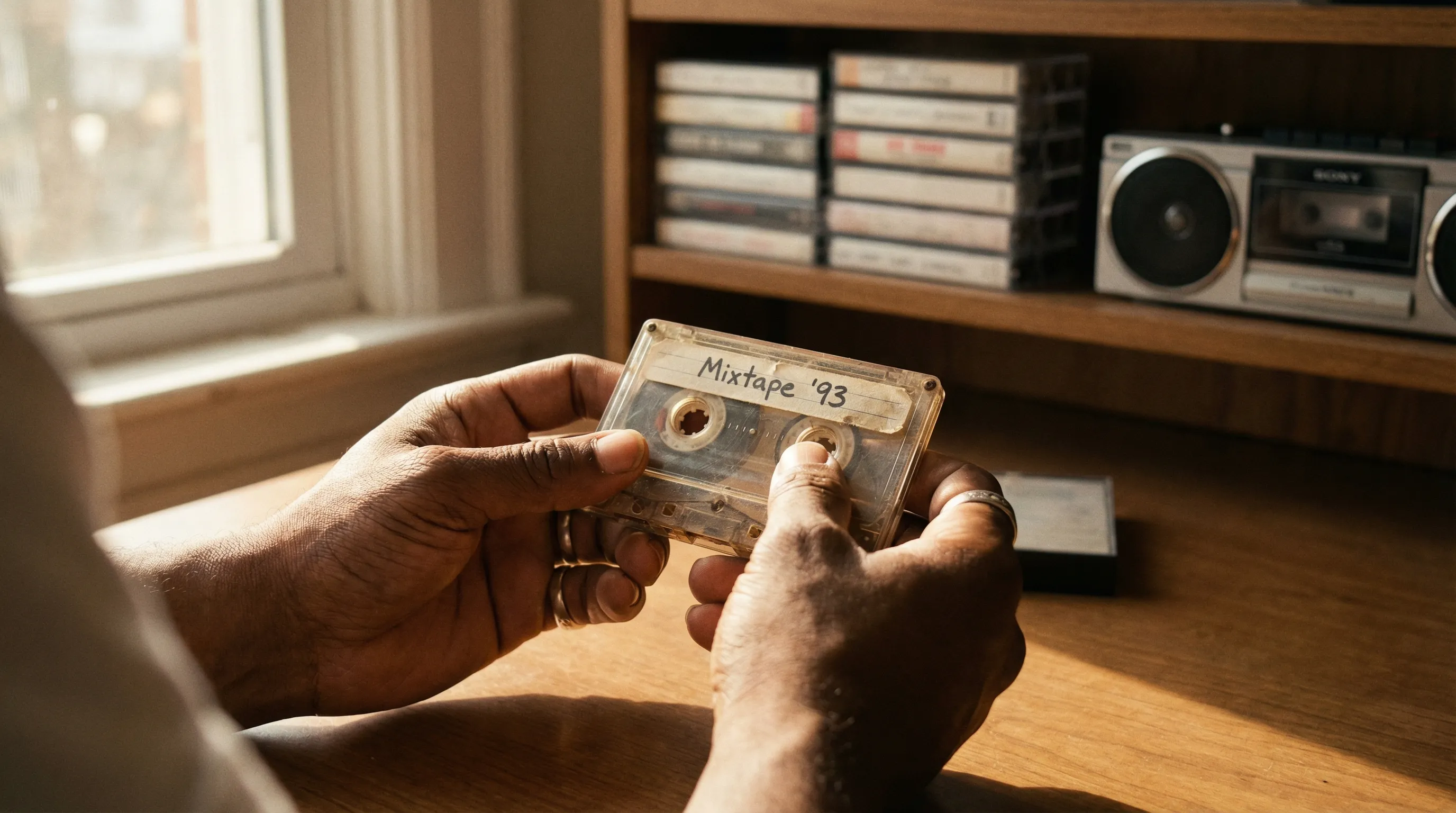
I spent my teenage years making mixtapes. Not the Spotify playlist kind—the real kind. Recording songs off the radio with my finger hovering over the pause button, timing tracks to fit perfectly on each side of a 90-minute cassette, writing liner notes by hand with a Sharpie. It was slow, meticulous, and completely absorbing.
Now I build AI systems.
The connection isn’t obvious until you realize: both are about curation, context, and creating something meaningful from tools that could easily be soulless.
The Mixtape Mindset: Constraints as Creative Fuel
Making mixtapes in the ’90s was an exercise in working within brutal constraints. You had 45 minutes per side. Once you hit record, there was no undo. If the DJ talked over the intro of a song you’d been waiting hours to record, you either kept it or started over.
These weren’t bugs—they were features. The limitations forced intentionality.
I’d spend an entire Saturday afternoon creating a single mixtape. First, I’d map out the sequence on paper—what song goes where, which transitions would flow naturally, how the mood should evolve across the tape. Then came the execution: timing each track to the second, manually adjusting volume levels between songs, creating those perfect fade-outs.
The art wasn’t in the songs themselves—it was in the curation, the sequencing, the story you told through your choices.
Sound familiar? It’s the exact mindset I bring to AI work today.
When I’m building a RAG system or designing prompts, I’m working within constraints: token limits, context windows, API costs. When I’m engineering a complex AI workflow, I’m sequencing operations—what happens first, where the handoffs occur, how the pieces flow together.
The best AI implementations aren’t about throwing unlimited compute at problems. They’re about thoughtful curation within constraints. Which context matters? What should the AI focus on? How do you sequence the operations to tell a coherent story?
Just like mixtapes, the art is in the choices you make, not just the tools you use.
Analog Intuition in a Digital World
There was a moment—maybe 20 seconds into a recording—when you’d know if it was going to work. The sound quality, the timing of when you hit pause, the way the song faded in. You couldn’t explain it with data. You just felt it.
Analog media taught you to trust that feeling.
When I’m debugging an AI system now, I use metrics and logs. But I also trust the same intuition. Does this output feel right? Is the AI’s reasoning following a natural path, or does something seem off even if the accuracy metrics look good?
This is the part they don’t teach in ML courses: Sometimes a model scores 95% but the 5% it gets wrong reveals a fundamental misunderstanding. Sometimes lower accuracy with better reasoning is more valuable than high accuracy through pattern memorization.
The tactile feedback loop of analog media—physically rewinding, listening again, adjusting—taught patience. You couldn’t rush it. You had to sit with the work, iterate slowly, build intuition over time.
Modern AI development demands the same patience. Yes, you can generate 100 variations in minutes. But do you understand why one works better than another? Can you feel when the system is making decisions versus just pattern-matching?
I don’t trust “black box” AI solutions precisely because of my analog upbringing. If I can’t understand the mechanism—if there’s no tactile feedback loop, no way to build intuition about why something works—then I can’t truly trust it. And I definitely can’t make it better.
The best AI builders I know share this quality: They want to understand the system deeply enough that they can feel when something’s wrong, even before the metrics tell them.
Curation Over Generation
Here’s what people misunderstand about mixtapes: I wasn’t making music. I was curating it.
The songs already existed. My job was to find them, select the right ones, put them in the right order, and create context that made them mean something new. The value I added was judgment—what fits, what doesn’t, what story emerges from this particular sequence.
This is AI’s real superpower, and most people miss it.
Everyone’s obsessed with AI generating things—images, text, code, music. But the more valuable application is AI augmenting human judgment. Helping you find patterns you’d miss. Organizing information so you can see the connections. Suggesting options you wouldn’t have considered.
This is why I built 99 Minds the way I did. The AI doesn’t think for you—it helps you organize your own thoughts. You capture ideas in voice notes (the raw material, like songs on the radio). The AI categorizes them, finds connections, surfaces related concepts. But you decide what matters. You curate. You create the meaning.
The 99 Minds principle: Never let a good thought die in your head. But also: The AI is your mixtape deck, not your DJ. You’re still the one with taste.
When I work with AI tools, I treat every output as a first draft. The AI generates suggestions—whether it’s code, writing, or system designs—and I curate. I refine. I bring the judgment that turns generated content into something with a point of view.
Too many people use AI as a replacement for thinking. They should be using it as a replacement for the tedious parts—the search, the organization, the initial drafts—so they can spend more energy on the parts that actually require human judgment.
Just like mixtapes. The cassette deck didn’t decide what music was good. It just made it possible for you to share your taste with the world.
Building Tools That Feel Human
The best analog technology had warmth. Not in a technical sense—cassettes were objectively inferior to CDs in every measurable way. But there was something about the format that felt human.
The slight imperfection. The tactile nature of holding a cassette. The liner notes written by hand. The knowledge that someone spent hours making this specifically for you.
This is what I’m after with digital tools.
When I design products, I’m constantly asking: Does this feel warm? Does it respect the user’s humanity? Or does it feel like you’re interacting with a cold, efficient machine?
Take 99 Minds’ voice interface. I could have built a traditional form: title field, description field, category dropdown. Efficient. Organized. Soulless.
Instead, I made it voice-first. You speak your idea naturally, as if you’re thinking out loud. The AI handles the organization later. This isn’t more efficient—it’s more human. It respects that ideas come messy and unformed, and the tool should meet you where you are.
Or consider the law firm tool I built. The lawyers didn’t want AI to write their briefs. They wanted AI to handle the research grunt work—finding relevant cases, summarizing precedents—so they could focus on the strategic thinking and persuasive writing. The human part.
This is what “AI-first” should mean: AI handles what AI does well (search, organization, pattern recognition), humans handle what humans do well (judgment, strategy, creativity, emotional nuance).
Too many products automate away the parts people actually want to do and force them to manage the parts that should be automated. That’s backwards.
The best technology amplifies human capabilities without making you feel like you’re operating machinery. Like a great mixtape deck: you barely thought about the technology. You thought about the music, the story, the person you were making it for.

The Future Is a Better Mixtape Deck
I’m not nostalgic for analog. Cassettes were frustrating. Recording quality was inconsistent. Tapes degraded over time. The limitations were real.
But the mindset analog taught me? That’s invaluable.
Constraints breed creativity. Curation matters more than generation. Intuition complements data. Technology should amplify human intent, not replace it. And the best tools fade into the background, letting you focus on what actually matters.
This is how I think about AI.
Not as magic. Not as a replacement for human thinking. But as a really, really good version of that old cassette deck—a tool that makes it easier to capture, organize, and share what’s in your head.
The difference? Modern AI is infinitely more capable. But the principles remain the same.
Know your constraints. Curate thoughtfully. Trust your intuition. Build tools that feel human. And remember: the technology isn’t the point. What you choose to do with it is.
I’m 40 now. Haven’t made a mixtape in decades. But every AI system I build, every product I design, every feature I debate—I’m still asking the same questions I asked at 15, sitting in front of a boom box with a stack of blank cassettes:
What story am I trying to tell? What should come first? How do I make this flow? What makes this mine?
The tools changed. The questions didn’t.
And that, more than any technical skill, is what growing up analog taught me about building with AI.
Related Posts
- The Modible Philosophy - The core principles behind everything I build
- Your MVP Is Trash - Why most MVPs fail and what to do instead
- 40-Year-Old Brain, New Game - Rebuilding systems for mid-life productivity