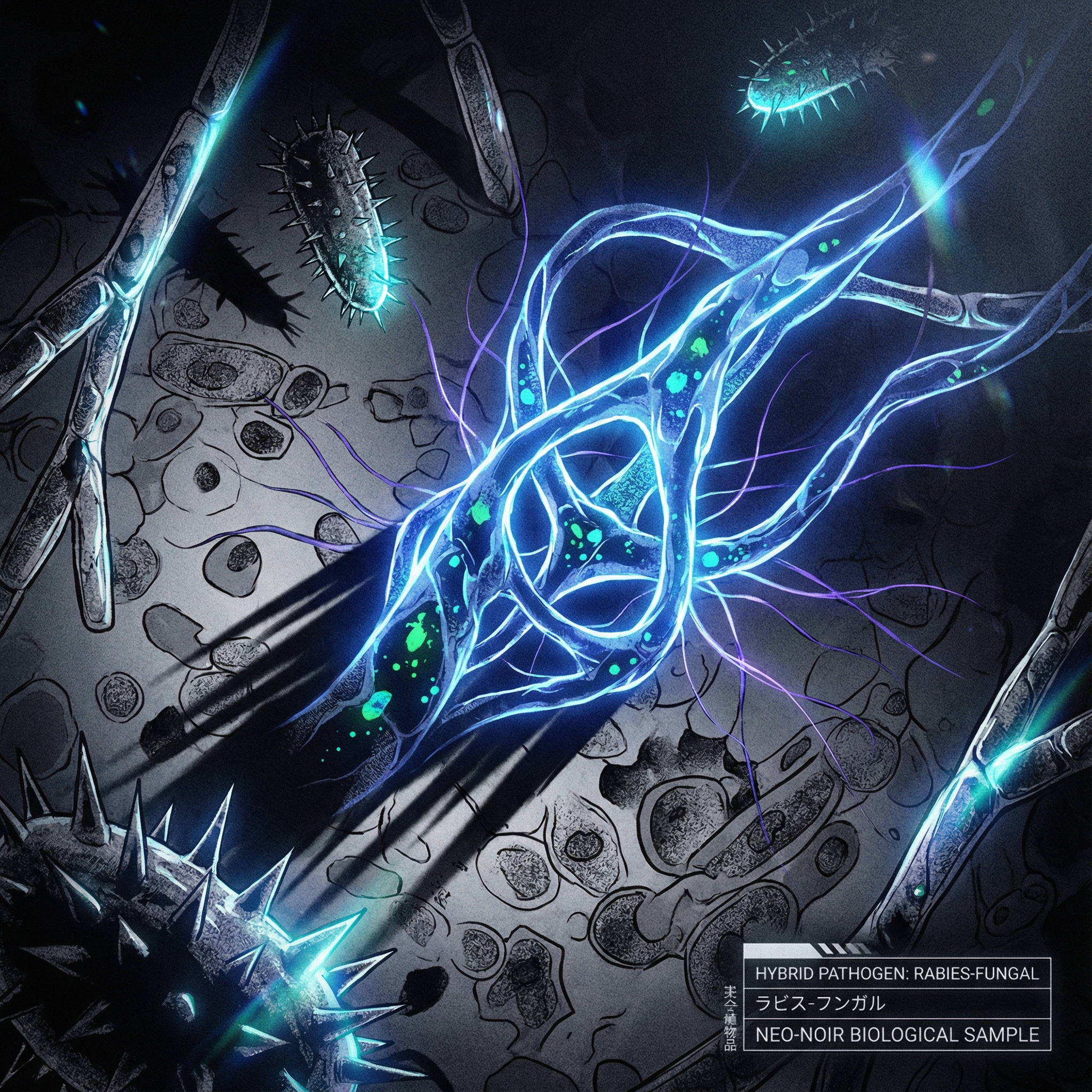
Classification
Official Designation: Eden Pathogen Alpha (EPA-1)
Informal Name: “The Eden Virus”
Classification: Engineered Hybrid Pathogen (Rabies/Cordyceps Derivative)
Biosafety Level: BSL-4+ (Theoretical Maximum)
Origin
The Eden virus was not born in nature. It was built—piece by piece, over nearly a decade, in laboratories funded by defense contracts and hidden behind shell companies. The goal was elegant in its horror: create a controllable outbreak.
The base was modified rabies lyssavirus, chosen for its neurotropic properties (affinity for nervous tissue) and its ability to induce aggressive behavior. The enhancement came from a synthetic compound derived from Ophiocordyceps fungi—the “zombie ant fungus” that has fascinated and horrified biologists for decades.
The combination was unprecedented. And devastating.
Transmission
Primary Vector: Fluid transfer (bites, blood contact)
Secondary Vector: Aerosolized particles (limited range)
Incubation Period: 4-48 hours (varies by exposure level)
Infectious Period: From initial symptoms until host termination
Unlike natural rabies, which takes days or weeks to manifest, the Eden virus was engineered for speed. The synthetic fungal component accelerates viral replication by hijacking cellular machinery in ways that shouldn’t be possible.
Stages of Infection
Stage 1: Onset (0-6 hours)
- Flu-like symptoms: fever, body aches, fatigue
- Increased aggression, irritability
- Photosensitivity begins
Stage 2: Progression (6-24 hours)
- Hemorrhaging from eyes, nose, ears
- Vascular system degradation
- Loss of higher cognitive function
- Compulsive behavior emerges
Stage 3: Transformation (24-48 hours)
- Fungal tissue begins visible growth beneath skin
- Complete loss of human consciousness
- Predatory hunting behavior activates
- Sensitivity to light increases
Stage 4: Integration (48+ hours)
- Full fungal integration with nervous system
- Enhanced strength and durability
- Coordinated behavior with other Stage 4 infected
- “Hive” intelligence emergence
The Hive Mind
The most terrifying aspect of the Eden virus is its Stage 4 development: the emergence of coordinated behavior among infected hosts.
The fungal component creates a distributed neural network, allowing infected individuals to share sensory information and coordinate hunting strategies. Stage 4 specimens serve as “nodes” in this network—queens in an infectious hive, capable of directing lesser infected toward prey.
This wasn’t an accident. This was the feature the Architects were most eager to demonstrate to buyers.
Vulnerabilities
Despite its engineered resilience, the Eden virus has weaknesses:
- Neural Dependency: Destruction of the brain stem terminates the infection
- Light Sensitivity: Infected are less active in bright sunlight
- Fungal Fragility: The fungal component is vulnerable to specific antiviral compounds
- Receptor Blocking: The cure exploits synthetic binding sites in the fungal tissue
The Cure
Dr. Elena Rodriguez, working with John Harrison, developed a treatment that targets the fungal component’s neural receptors. For Stage 1-2 infections, the treatment can reverse the transformation entirely. For Stage 3 and beyond, the neural damage is too extensive—termination remains the only option.
Current Status
All known samples of the original Eden virus strain were destroyed in the facility’s demolition. However, the Architects possess the development data and the capacity to recreate it.
Six other facilities. Six potential outbreaks.
The Harrisons are working to ensure none of them ever happen.
Research Notes
From the recovered files of Dr. Elena Rodriguez:
“The elegance of this thing would be beautiful if it weren’t so horrifying. They took nature’s most efficient predator—a virus—and merged it with nature’s most efficient controller—a fungus. The result is something that doesn’t just kill. It recruits.
Every victim becomes a vector. Every infected becomes a hunter. The more it spreads, the smarter it gets.
Whoever designed this knew exactly what they were doing. They didn’t just want to kill people. They wanted to convert them.
That’s not warfare. That’s farming.”