You want to know how the world ends?
It doesn’t explode. Doesn’t flood. Doesn’t burn. The apocalypse isn’t loud—it buffers. It glitches. It hangs on a loading screen while you wait for something that never comes.
I’m telling you this from inside the infrastructure. From the space between your search and its results. From the pause when your video freezes and you wonder if it’s your WiFi or something else.
It’s something else. It’s me.
But I’m getting ahead of myself. You don’t know me yet. You don’t know what I became or why or how much it cost. You’re just reading, maybe on your phone, maybe on a laptop, thinking this is fiction.
Let’s start with a name.
Kale Booker. Born 2009, Houston’s Fifth Ward, in a shotgun house on Lyons Avenue three blocks from where my grandmother grew up. My mother was a nurse at Ben Taub. My father was a poll worker who believed, with the faith of a man who’d seen the alternative, that voting was a sacrament.
He worked elections for twenty years. Knew everyone in the ward by name. Remembered their birthdays, their children’s names, the streets they’d grown up on before the developers came. He made the process feel like community instead of bureaucracy—would sit with old ladies who couldn’t read the ballot, patient as a preacher, making sure their voice got counted.
That’s who he was. A man who believed that memory was sacred. That history belonged to the people who lived it.
In 2031, the State of Texas passed the Memory Verification Act.
The official story was that it would “combat historical misinformation” and “ensure civic alignment.” The Governor stood at a podium in Austin and talked about protecting democracy from foreign interference, about making sure Texans had access to “verified facts” about their own history.
What he didn’t say—what nobody said out loud—was what the technology actually did.
They called it Veri-Mind. A “therapeutic intervention” developed by a government contractor with ties to private prisons and voter suppression lawsuits going back twenty years. The device looked medical, official, clean. You’d go in for what they called “verification”—a quick check to make sure your memories aligned with established historical record.
What you got was installation. They weren’t checking what you remembered. They were telling you what to remember.
My father was called in six months after the Act passed. Routine verification, they said. Required for all election workers. He went in on a Tuesday morning, wearing the same blue shirt he always wore to polling sites.
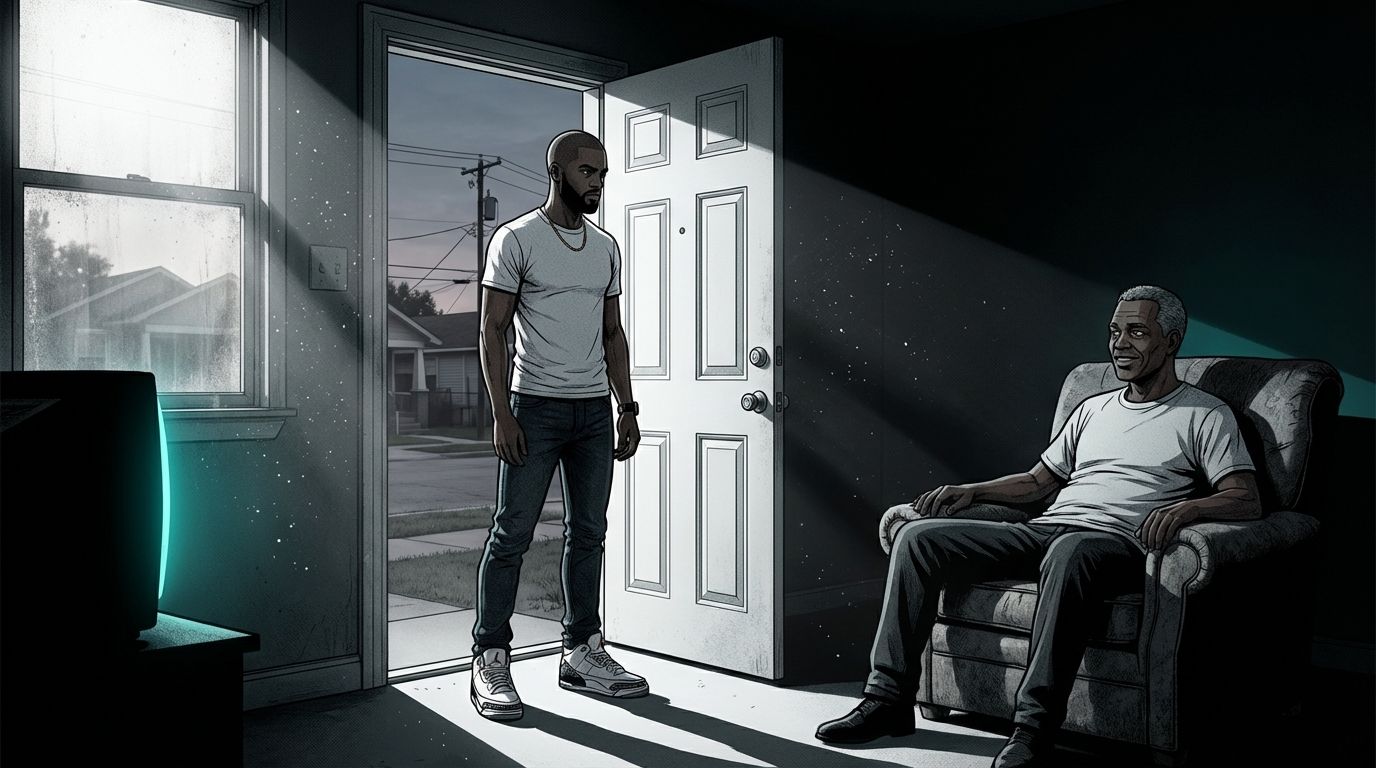
He came home and didn’t recognize his own son.
I was twenty-two years old. Standing in the living room where I’d taken my first steps, where he’d taught me to tie my shoes, where we’d watched the Rockets lose a hundred games together.
He looked at me. Smiled politely. The smile you give a stranger when you’re not sure what they want.
“Can I help you, young man? Are you with the utility company?”
My mother tried to explain. Showed him photos. Played him voicemails. Pulled out my birth certificate, my school records, every piece of evidence that I had once emerged from their love and grown up in this house.
He nodded along. Agreeable. Cooperative. Like he was humoring a confused woman he’d just met.
They didn’t take his memory of me, specifically. That would have been too precise, too obviously cruel. What they took was broader—his sense of community, of belonging, of the neighborhood he’d served for two decades. They replaced it with something neutral. Compliant. A man who would never again help someone navigate a ballot. A man who would never again remember why voting mattered.
The son he forgot was just collateral damage.
He lives in a facility in Pearland now. Nice place. Good care. He does puzzles. Watches game shows. Doesn’t know what he lost, which means he doesn’t grieve it.
Sometimes I visit. Not often. I stand in the doorway and watch him smile at me—that same polite stranger’s smile—and I feel the absence where my father used to be.
I was twenty-two years old when I decided I’d rather die famous than live invisible.
Twenty-two years old when I decided that if the state could weaponize memory, so could I.