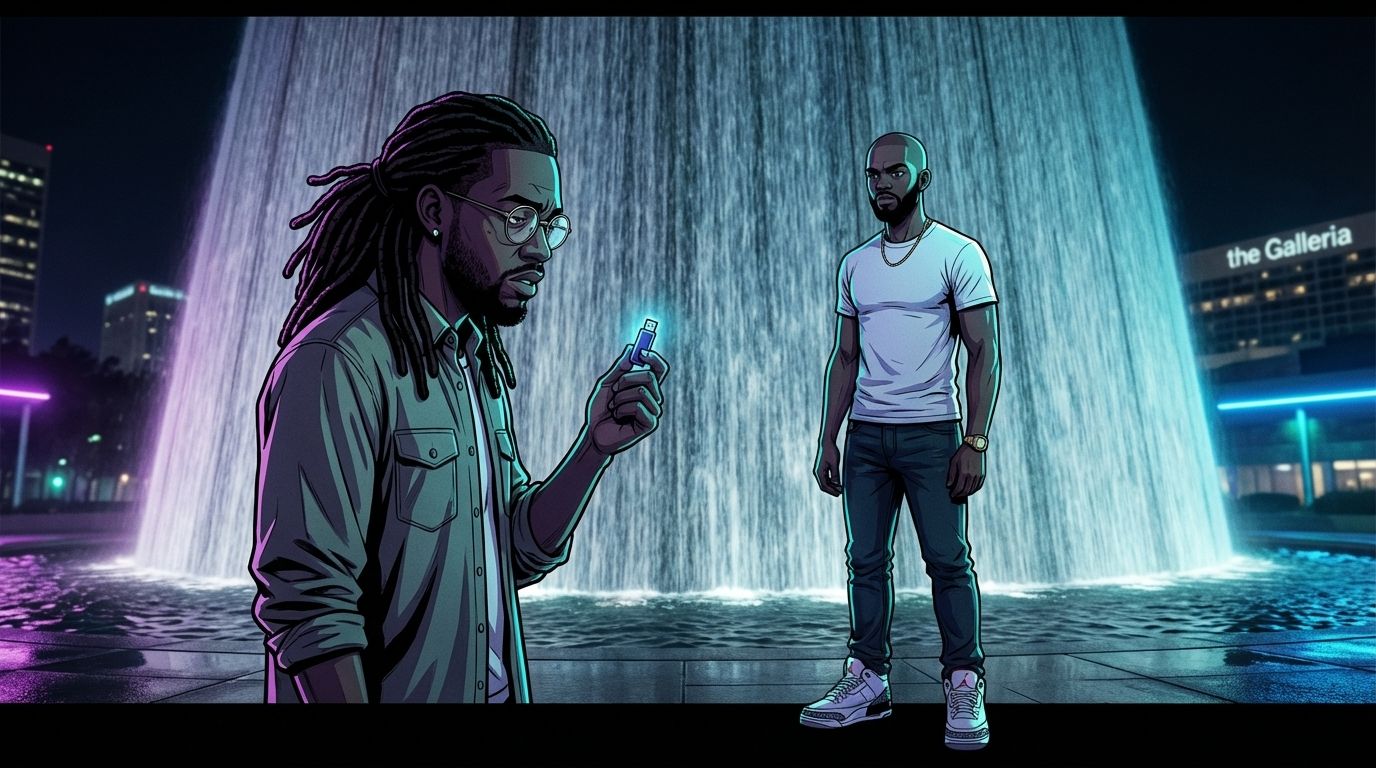
I met Marcus Delacroix at the water wall.
You know the one—that curved sheet of water behind the Galleria where every Houston kid takes their prom photos. Sixty-four feet of cascading noise, water recycling endlessly over granite, tourists posing in front of it like they discovered something the city hadn’t known about for forty years.
I was there because a girl I was trying to impress wanted pictures. Marcus was there because he was calculating something. I could see it in his face—the way he stared at the water like it was hiding a math problem.
“Structural inefficiency,” he said, not to me, just out loud. “The pump system loses thirty percent to heat dissipation. You could power a small neighborhood with what this thing wastes.”
The girl I was with gave me a look. Who is this weirdo?
But I was interested. Not in the engineering—in the mind that saw engineering everywhere. The kind of mind that couldn’t look at anything without trying to understand how it worked.
“You an engineer?” I asked.
He looked at me for the first time. Glasses, rumpled shirt, the permanent exhaustion of someone who slept when his body forced him to and not a minute before.
“Was. Rice. Dropped out.”
“Why?”
“Because the things I wanted to build weren’t on the curriculum.”
That should have been the end of it. Two strangers at a tourist spot, making small talk, moving on. But he looked at me—really looked, like he was calculating something else now—and said:
“You’re from Fifth Ward.”
It wasn’t a question. I didn’t know how he knew, and I didn’t ask.
“You’ve seen what they’re doing,” he said. “The Verification Act. The installations.”
My whole body went cold. “My father—”
“I know.” He reached into his pocket and pulled out a thumb drive. “I’ve been working on something. Something that could fight back. But I don’t know how to get it to people. I know code. I don’t know distribution.”
“What is it?”
He looked around. The water wall roaring, tourists laughing, the Galleria looming behind us like a monument to consumption. Then he leaned in.
“They’re using memory as a weapon. I figured out how to use it as a gift.”
Marcus’s lab was a converted garage in Second Ward, crammed with equipment that looked like it had been liberated from a dozen different sources. Medical monitors. Server racks. Wires snaking across the floor like a nervous system exposed.
In the middle of it all was a chair. Modified dental chair, the kind you see in cheap clinics. Cables ran from the headrest to a bank of machines humming with purpose.
“The government’s tool is a bulldozer,” Marcus said, pulling up schematics on a monitor. “Veri-Mind overwrites wholesale. It doesn’t care about precision because it’s not trying to help anyone—it’s trying to control them. But memory doesn’t work that way. Memory is delicate. Specific. It’s not just data; it’s emotion, sensation, context.”
He showed me the code—not that I understood it, but I understood his excitement. The way his hands moved when he talked about neural pathways and emotional encoding.
“I reverse-engineered their system. Figured out how to write memories instead of just erasing them. But not propaganda—not their version of history. Real memories. Specific ones. The taste of your grandmother’s cooking. The feeling of your first kiss. The sound of your mother’s voice.”
“Why?”
He stopped. Looked at me with those exhausted eyes.
“My sister, Lena. She was in an accident two years ago. Memory damage. She lost—” He paused. “She lost pieces of herself. Our childhood. Our mother’s face. She doesn’t remember that I’m her brother.”
I thought about my father. The polite stranger’s smile.
“I’ve been trying to fix her,” Marcus said. “That’s why I started this. But I can’t give her memories that don’t exist anymore. Our mother is dead. Our childhood is gone. The only way to restore what Lena lost is to find similar memories somewhere else. Copy them. Adapt them. Install them.”
“That’s possible?”
“That’s what Echo does.” He gestured at the chair. “The technology exists. The government proved that. I just made it precise. Made it beautiful.”
He looked at me again. That calculating look.
“But I can’t do anything with it alone. I’m not—” He struggled for the word. “I don’t know how to talk to people. How to reach the communities that need this. I can build the engine, but I don’t know how to drive.”
I understood then what he was offering. And what he was asking.
“Show me,” I said.