Three months.
That’s how long we had. Three months of Sienna falling asleep on my couch while I pretended to watch whatever documentary she’d put on. Three months of arguments that turned into conversations that turned into silence that didn’t need filling. Three months of her stealing my hoodies and me pretending to be annoyed about it.
I didn’t tell her everything. Couldn’t. There were parts of the operation she was better off not knowing—the supply chains, the money, the arrangements with people whose names I’d never put in writing.
But I told her about my father.
We were in bed—my bed, which had become our bed without either of us discussing it. The apartment was dark except for the Houston skyline through the window, that permanent orange glow that passes for stars in a city too bright for real ones.
“What happened to him?” she asked. “The real reason you started this.”
I told her. The poll worker who believed voting was a sacrament. The verification that wasn’t verification. The polite stranger’s smile.
She didn’t say anything for a long time. Then she put her hand on the back of my neck and held it there. Not trying to fix anything. Just staying.
That’s the thing about Sienna. She didn’t try to fix anything. She just stayed.
The operation was growing faster than I could track.
Marcus had trained three other technicians. We had distribution points in Third Ward, Acres Homes, and Sunnyside. The memory rides were booked two weeks out. The product list had expanded to dozens of variations—custom packages for grief, confidence, nostalgia, connection.
I bought back my mother’s house. The one the bank had taken after my father got verified, after the medical bills ate through their savings, after everything fell apart. Paid cash to a developer who’d been planning to tear it down for townhomes.
I didn’t go inside. Just stood on the sidewalk, looking at the place I’d grown up, holding the deed in my hands.
Trap found me there. Stood next to me, quiet the way he always was.
“You going to live in it?”
“No.”
“Then why buy it?”
I didn’t have a good answer. The house wasn’t what I missed. My parents were what I missed. The version of my life where my father still knew my name and my mother wasn’t exhausted from trying to manage his care.
You can’t buy that back. No matter how much money you have. No matter what technology you control.
“Some things are just supposed to be yours,” I said finally. “Even if you can’t use them.”
Trap nodded like that made sense. Maybe it did.
I bought a slab that made grown men stop traffic just to watch it pass.
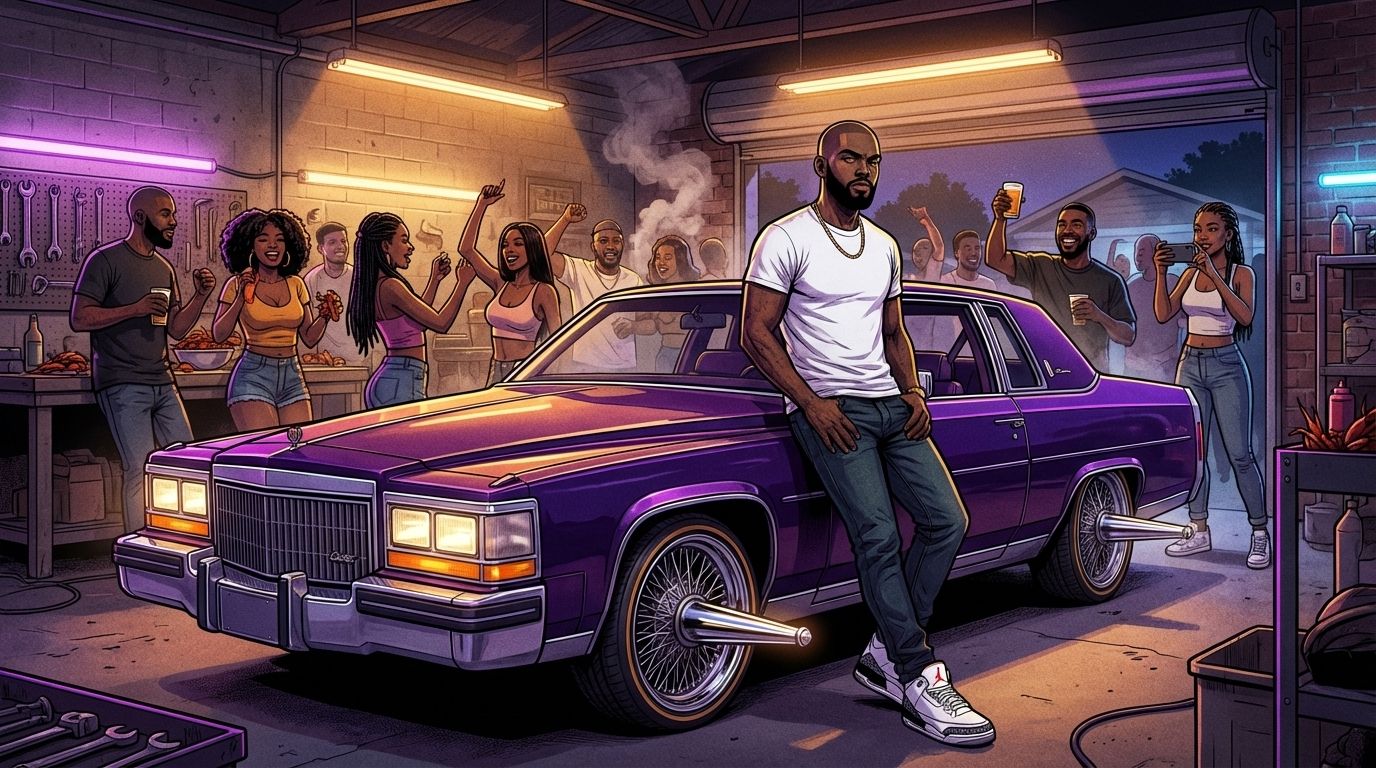
A 1983 Cadillac Coupe de Ville, rebuilt from the frame up, painted a purple so deep it looked like a bruise you wanted to touch. The swangas caught Houston sunlight and threw it back like a threat. The trunk setup held the most advanced memory installation rig we’d ever built—a mobile clinic, a showroom, a temple on wheels.
Sienna saw it and laughed.
“You’re performing,” she said. “Who are you performing for?”
“Everyone.” I ran my hand along the hood. “No one. The version of me that used to count quarters for the bus.”
“The car’s not for you. It’s for them.”
“Them?”
“Everyone who said you’d never be anything. Your father who can’t remember you were anything.” She looked at me with those sharp eyes. “You’re trying to become undeniable. You think if you get big enough, loud enough, visible enough—no one can ever erase you.”
I didn’t have a response. She’d seen something I hadn’t admitted to myself.
“It won’t work,” she said. Gently. “You can’t outrun that kind of wound. You can only learn to live with it.”
“And if I can’t?”
She touched my face. “Then you’ll keep running. And one day you’ll look around and realize you ran so far you can’t find your way back.”
I kissed her. Partly because I loved her. Partly because I didn’t want to hear what else she might say.
Dom arrived on a Tuesday.
A black sedan pulled up to the garage—sleek, expensive, looking like a government vehicle that had gone freelance. The windows were tinted past legal. The driver stayed inside.
The man who emerged was maybe forty-five, wearing a suit that probably cost more than my mother’s house. He looked around Trap’s garage—the tools, the slabs in progress, the empire I was building—with the expression of someone evaluating an acquisition.
“Mr. Booker.” He extended his hand. “Dominic Williams. But please—call me Dom.”
I didn’t shake. “I don’t remember making an appointment.”
“No.” He smiled. “I don’t make appointments. I make opportunities.”
He walked through the garage without asking permission. Touched a swanga like he was checking its construction. Examined one of our memory rigs with what looked like professional familiarity.
“You’ve built something interesting,” he said. “Grassroots distribution. Community trust. Quality product. It’s the kind of operation venture capitalists would kill to understand.”
“We’re not looking for investors.”
“I’m not offering investment.” He turned to face me. “I’m offering partnership. Or more accurately—I’m offering you a choice between partnership and obsolescence.”
I felt Trap tense beside me. Saw Marcus drift toward the back of the garage where we kept the hardware that mattered.
“That sounds like a threat.”
“It’s not a threat. It’s a market reality.” Dom pulled out a phone, showed me a screen full of data. “The government contracts for memory modification are going private next year. Five companies are competing for implementation rights in twelve states. I’m positioned to control three of them.”
He put the phone away.
“You’re good at this. Better than I expected. But you’re playing with toys. I’m building infrastructure. When the market scales—and it will—there will be room for operators or there will be room for products. You can be the operator. Or you can be something I acquire on my way to something larger.”
“I’m not for sale.”
“Everything’s for sale, Mr. Booker. The only variable is price.” He reached into his jacket and produced a card. Laid it on the workbench like he was laying down a bet. “Think about it. You have something valuable—community trust, cultural authenticity, the kind of access that can’t be bought directly. I have resources you can’t imagine. Together, we could build something that matters.”
“We already built something that matters.”
“You built a hobby.” His voice hardened. “A beautiful, heartfelt hobby that helps a few hundred people and makes you feel righteous. I’m building an empire. And empires require choices.”
He walked toward the door. Paused.
“I’m from the Fifth Ward too, you know. Same streets. Different decade. I know what it’s like to want to matter. To want to be so big that no one can ignore you.”
He looked at me. And for a moment, I saw something behind the corporate mask—hunger, old and familiar.
“The difference between us is that I stopped pretending the world would reward me for being good. I started making the world pay me for being necessary.” He smiled. “You’ll figure that out eventually. I just hope it’s before someone else figures it out for you.”
He left. The black sedan pulled away.
Trap exhaled. “That man is dangerous.”
“Yeah.”
“What are you going to do?”
I picked up Dom’s card. Turned it over. Nothing on it but a phone number.
“I’m going to prove him wrong.”
We celebrated that night.
The whole crew—Trap, Marcus, the technicians we’d trained, the community members who’d become part of our network. Someone brought crawfish. Someone else brought Hennessy. Music played from a trunk setup, bass rattling the garage walls.
I stood in the middle of it all and felt invincible.
We’d built this. From nothing. From grief and anger and the refusal to be erased. We’d created something the system couldn’t control, couldn’t buy, couldn’t destroy.
Dom was wrong. We didn’t need his empire. We had something better—community, purpose, love. Sienna was there, filming everything, laughing at something Trap said. Marcus was actually smiling for the first time in months.
This was what it was supposed to be. This was the dream.
I drank too much. Danced badly. Let myself believe that we’d won.
And in the corner of the garage, barely visible in the crowd, one of our earliest clients was buffering.
His name was Jerome. We’d given him a memory of his grandmother’s voice—she’d raised him, died when he was sixteen, and he’d been carrying the loss ever since. The install had been perfect. He’d cried with gratitude.
Now he was standing frozen. Face slack. Eyes unfocused. His drink had slipped from his hand and was spreading across the concrete floor.
“Jerome?” I pushed through the crowd. “Jerome, you okay?”
Nothing. No response. He was there but not there—a system frozen mid-process.
Marcus saw it too. His smile vanished. He crossed the garage in three steps, pulling out a handheld diagnostic from his pocket.
“Echo bleed,” he said quietly. “His installed memory is interfering with his baseline cognition.”
“Can you fix it?”
Marcus didn’t answer. Which was answer enough.
Jerome blinked. Shook his head. Looked around like he’d just woken up.
“Sorry,” he said. “I just—I lost a second there.”
“You’re fine.” I clapped him on the shoulder. “Happens to everyone.”
But I felt Miss Addie’s eyes on me from across the garage. And I heard her voice in my head:
You’re building a museum. And you know what happens in museums?
Jerome went back to the party. I went outside. Stood in the Houston night, tasting the humidity and the gasoline and the distant refineries.
Something had shifted. I couldn’t name it yet. But I felt it.
The first crack in the foundation.
The beginning of the fall.