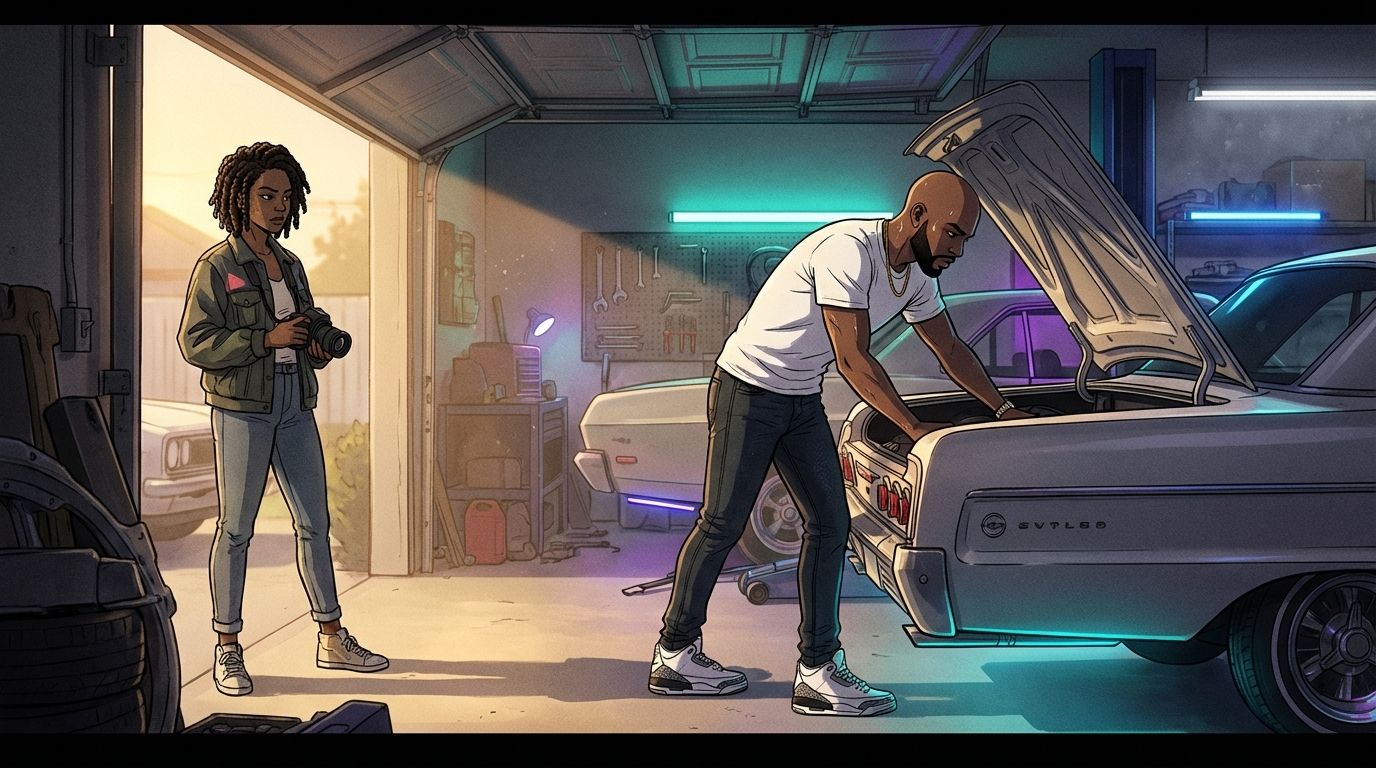
She showed up at Trap’s garage on a Thursday afternoon, carrying a camera and asking questions I didn’t want to answer.
“I’m looking for someone called Kale.”
I was elbow-deep in a trunk setup, running cable for the latest memory rig. Didn’t look up. “Depends who’s asking.”
“Sienna Price. I’m a documentarian.”
That made me look up.
She was medium height, natural hair in twists, wearing a jacket that looked expensive enough to be out of place in the Fifth Ward but worn enough to suggest she’d been places. Her camera was professional—the kind that cost more than most people’s cars.
But it was her eyes that stopped me. Sharp. Analytical. Looking at me like I was a puzzle she was deciding whether to solve or throw away.
“I’m making a film about memory modification,” she said. “The legal industry and everything that’s grown up around it. Someone at the Medical Center mentioned your name.”
“They shouldn’t have.”
“Probably not.” She smiled. It was a challenge. “But they did. And I’ve been tracking the supply chain for six months. Veri-Mind hardware showing up in places it shouldn’t be. Reports of unauthorized installations that sound therapeutic rather than punitive. A shadow market for something the government insists doesn’t exist.”
She tilted her head. “The trail leads here. To a slab shop in Fifth Ward. To someone who calls himself—” she checked her notes, “—the Memory Broker.”
I should have denied everything. Should have sent her away and moved the operation somewhere she couldn’t find.
Instead, I said: “That’s a stupid name. I never called myself that.”
She laughed. A real laugh, surprised out of her, like she was annoyed at herself for finding me funny.
That’s when I knew I was in trouble.
I let her film.
I told myself it was strategy. If she was going to make a documentary either way, better to shape the narrative than let her construct it without me. Control what she saw. Manage the message.
That was a lie. The truth was simpler and more dangerous: I wanted her to see me.
Not the operation. Me. The version of myself that was trying to do something meaningful. The version that believed in what we were building.
She followed us for three weeks. Watched installs. Interviewed clients—with their permission, faces obscured. Asked questions that cut closer than I expected.
“Where does it stop?” she asked one night, after watching a woman receive a memory of her dead husband’s laugh.
“What do you mean?”
“The technology. You can install a memory of a meal. A memory of confidence. A memory of a neighborhood that doesn’t exist anymore.” She was filming me, the camera an extension of her attention. “What happens when someone asks you to install something else? A memory of a crime they didn’t commit. A memory of a vote they didn’t cast.”
“That’s not what we do.”
“But you could.”
I didn’t answer.
“That’s what I’m trying to understand,” she said. “You’ve built something powerful. Maybe the most powerful technology anyone’s ever had access to outside a government contractor. And you’re using it for—what? Diet memories and confidence boosts?”
“We’re helping people.”
“You’re selling experiences. There’s a difference.” She lowered the camera. Looked at me directly. “I’m not saying you’re doing something wrong. I’m asking where the line is. Where it will be when someone offers you enough money to cross it.”
“You don’t know me.”
“No,” she agreed. “That’s why I’m asking.”
The real reason she was there came out three weeks later.
We were at the water wall—late, after the tourists had gone, just the two of us and the sound of water recycling endlessly. She’d stopped filming. Had started talking to me like a person instead of a subject.
“My mother was a city councilwoman,” she said. “In San Antonio. She opposed the Memory Verification Act when it was still being debated. Called it unconstitutional. Called it the most dangerous legislation she’d seen in thirty years of public service.”
I waited. The water roared.
“She was invited to participate in a pilot program. ‘Civic alignment research,’ they called it. Voluntary. Compensated. She thought she was helping collect data to fight the bill.”
Sienna’s voice was steady, but her hands weren’t.
“She came back supporting the Act. Enthusiastically. Gave interviews praising the technology. Voted for implementation when it reached her district.”
“Jesus.”
“She’s on a state advisory board now. Travels around giving speeches about the importance of verified memory in democratic society.” Sienna looked at the water. “She doesn’t remember that she has a daughter.”
The words hung there.
“I’ve tried to contact her twice. Both times, she smiled politely and asked if we’d met before.” Sienna laughed—the saddest sound I’d ever heard. “The woman who raised me. Who taught me how to hold a camera. Who told me that truth was the only thing worth chasing.”
“Sienna—”
“I’m not here to make a documentary about you, Kale. I mean, I am. But that’s not why I started looking.” She turned to face me. Eyes bright with something between grief and rage. “I’m trying to find out who did this to her. Who authorized the program. Who developed the specific technology that could make a mother forget her own child.”
“And you think I know?”
“I think you know more than you’re telling me. I think you have access to networks and information I can’t reach. And I think—” She stopped. “I think you might actually be one of the good ones. Which means you might help me.”
I should have walked away. Should have kept my distance from someone investigating the same world I was profiting from.
Instead, I reached out and touched her hand. She didn’t pull away.
“I’ll help,” I said. “Whatever I can do.”
She nodded. Didn’t thank me. Just stood there in the roar of the water wall, holding my hand like it was keeping her from floating away.
That was the beginning.