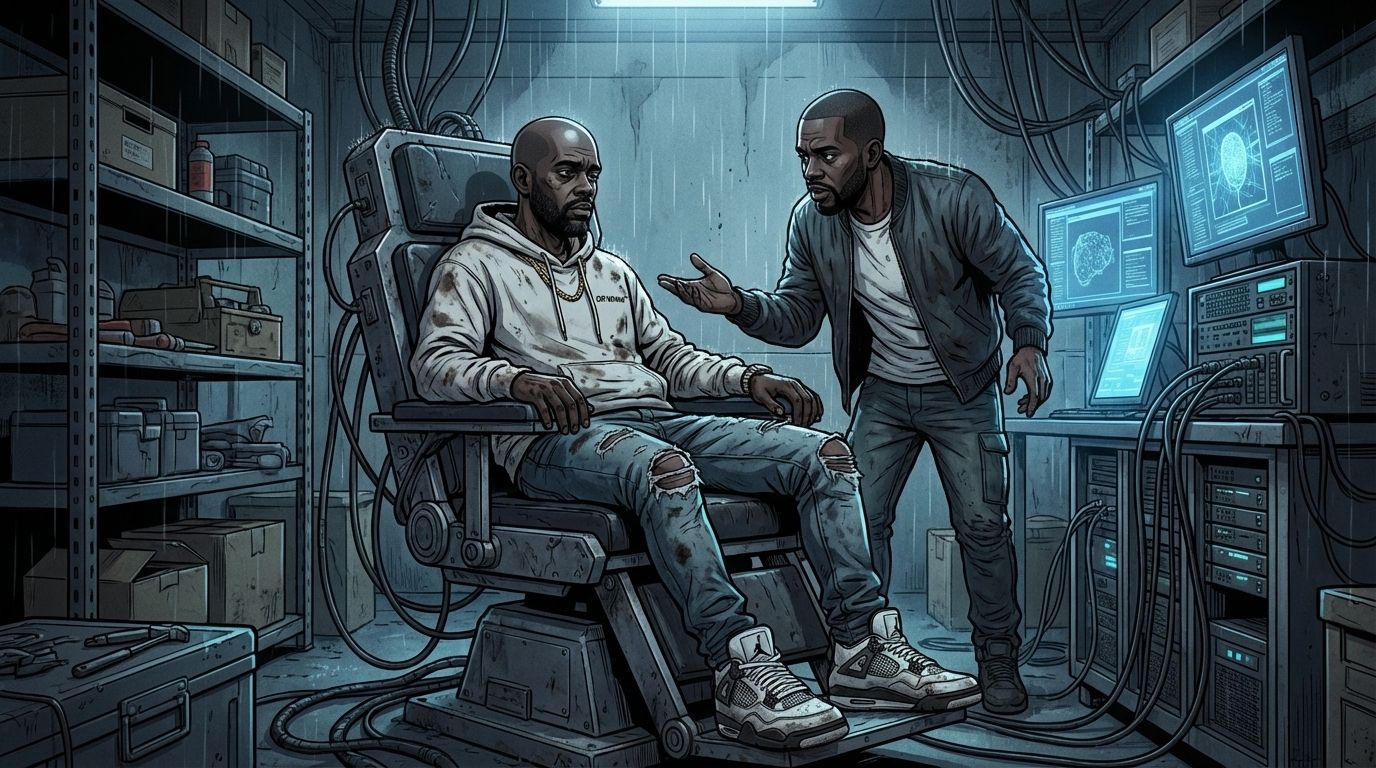
Marcus was out on bail when I found him.
His lab had been seized, but he had a backup location—a storage unit in Pasadena where he’d been hiding his most sensitive work. The kind of work he hadn’t told anyone about.
“I didn’t think you’d come,” he said when I walked in.
“I didn’t either.”
The storage unit was cramped, cluttered with equipment I didn’t recognize. Screens showed data I couldn’t interpret. In the center of it all was a chair—not the repurposed dental equipment we’d used for Echo, but something heavier. Industrial.
“What is this?”
Marcus was quiet for a moment. Then he pulled up a schematic on one of the monitors.
“I’ve been working on something. Since before—” He gestured vaguely at everything. “Since I knew this would fall apart.”
“What kind of something?”
“A failsafe.” He zoomed in on the schematic. “Echo installs memories. This does something different. It uploads them.”
“Uploads them where?”
“Everywhere. Anywhere.” He looked at me. “The internet. The cloud. Whatever you want to call the infrastructure that connects everything. This device can transfer a complete consciousness—not just memories, but the entire architecture of a mind—into that space.”
I stared at the schematic. At the chair.
“You’re talking about digitizing a person.”
“I’m talking about saving one.” His voice cracked. “I built this for Lena. She’s running out of time. Her mind is collapsing faster than I can repair it. If I can upload her before—”
He stopped. Couldn’t finish the sentence.
“Would she still be her?”
“I don’t know.” He laughed—the same broken sound I’d heard before. “I don’t know what consciousness is. Nobody does. But I know what death is. And this might be the only alternative.”
“What do you call it?”
He looked at the chair. At the screens. At the years of work that had led to this moment.
“Unavailable,” he said. “Because once you’re uploaded, you can never be reached again. Not in the way that matters. You’re everywhere and nowhere. Present and absent. There’s no phone number, no address, no way to connect.”
“You’d be alone.”
“You’d be alive.” He turned to face me. “Or something like alive. I don’t know what to call it.”
I thought about Trap, sweeping the floor of an empty garage. About Miss Addie, vacant on a street corner. About my father, smiling politely at a son he couldn’t recognize.
“Has anyone tested it?”
“No.” Marcus sat down heavily. “Lena can’t consent anymore. She doesn’t understand what I’m proposing. And I can’t—” His voice broke. “I can’t test it on myself. If it fails, she has no one.”
I understood then what he was asking.
“You want me to do it.”
“You’re degrading too.” He pulled up another screen—brain scans, neural maps. “The years of proximity to Echo technology. The installation you did in the jury program. The glitches you’ve been hiding from everyone.”
I hadn’t realized he knew. But Marcus knew everything about his own technology.
“The bleed is in you,” he said. “Slower than the knockoff users, but progressing. In six months, maybe a year, you’ll start losing coherence. The process is irreversible.”
“How long before—”
“Before you become a Blanker?” He shook his head. “I don’t know. Could be years. Could be months. But it’s coming.”
I looked at the chair. At the equipment surrounding it. At the screens showing a consciousness architecture waiting to be filled.
“If it works,” Marcus said, “you’d be proof of concept. You’d be beyond Dom’s reach. Beyond anyone’s reach. And maybe—maybe you could fight back from inside the system.”
“And if it doesn’t work?”
“Then you die.” He was honest about it. Had always been honest about it. “The upload is destructive. You can’t copy a mind—you can only move it. The biological hardware doesn’t survive the transfer.”
I thought about what I’d be leaving. An apartment I’d stopped sleeping in. A family that didn’t know me anymore. A woman who’d exposed me to the world and walked out of my life.
What did I have left to lose?
“How soon can you be ready?”