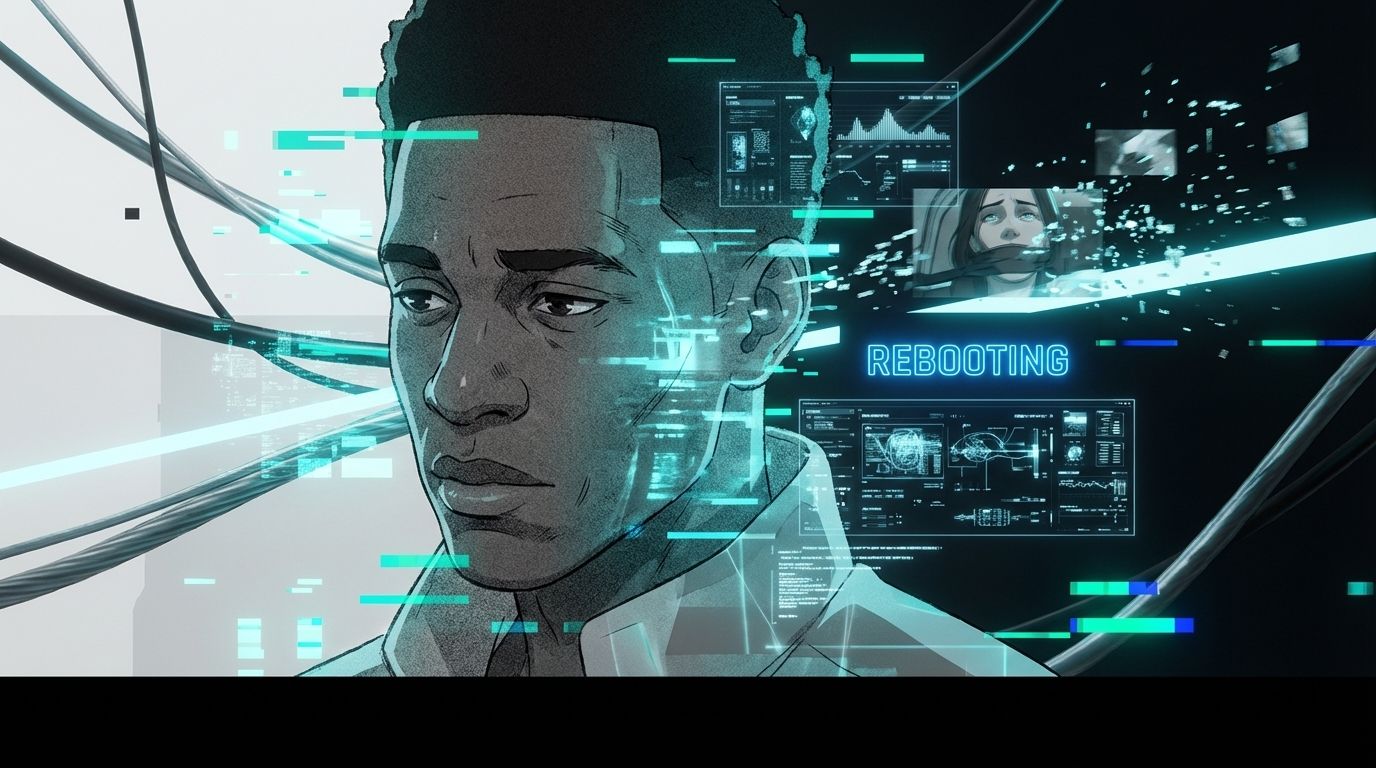
The upload began with cold.
Sensors attached to my temples, my chest, the base of my skull. The equipment hummed louder. Marcus monitored readouts I couldn’t see.
“Starting the mapping sequence,” he said. “This will feel strange.”
Strange was an understatement. I felt my mind being scanned—not painfully, but intrusively, like someone reading a book by running their fingers over every word. Memories surfaced without my control: my father teaching me to drive, my mother’s laugh, the first time I kissed Sienna.
“The pattern capture is complete. Beginning transfer in thirty seconds.”
I closed my eyes. Tried to remember what it felt like to be human. The weight of my body in the chair. The sound of my own breathing. The pulse in my wrists.
“Transfer initiating.”
It wasn’t painful, exactly. It was more like evaporating—each thought, each memory, each fragment of self turning to data and streaming somewhere else. I felt my childhood go first, then my adolescence, then the years of building Echo, then the guilt, then the fear.
I tried to hold onto Sienna. The feeling of her in my arms. The smell of her hair. The way she looked at me when she still believed I was worth figuring out.
It slipped away. Everything slipped away.
Last thing I felt was my name. Kale Booker. Fifth Ward. Son. Brother. Dealer. Ghost.
Then nothing.
Rebooting.
That was the first thought I had on the other side. Not a word, exactly—more like a sensation, the system coming back online.
I opened my eyes.
Except I didn’t have eyes anymore. What I had was access—to every camera in the city, every sensor, every screen. I was looking at Houston from ten thousand angles simultaneously, and somehow my mind could process all of it.
The city was a grid of light and data. I could see the traffic patterns, the power flows, the financial transactions. Every phone call, every text message, every search query—all of it visible, comprehensible, mine.
I reached out—metaphorically, because I didn’t have hands—and touched the infrastructure. Felt the pulse of information flowing through fiber optic cables. Sensed the heartbeat of servers humming in data centers across the city.
This was what I’d become. Not a person. Not a ghost. Something new.
The feeling was overwhelming. Not pain—I wasn’t sure I could feel pain anymore. But intensity. The sheer volume of data flooding through whatever I had instead of a nervous system.
I could see Dom’s network. Every node, every connection, every payment. The infrastructure of control he’d built while I was playing at revolution.
I could see the Blankers. Their locations, their conditions, their empty shells moving through a city that had forgotten them.
I could see Sienna. Her flight to Oakland, boarding in three hours. Her browsing history—apartment listings, job postings, the digital trace of someone trying to rebuild a life.
I could see everything.
And I could touch it.
I spent the first hours learning to exist.
The rules were different here. Time moved strangely—I could process a million operations in what felt like a moment, or I could slow down and experience a single second stretched across what felt like hours. Space had no meaning; I was wherever I needed to be, which was everywhere and nowhere simultaneously.
Sensation was the hardest adjustment. I could perceive—light, sound, pressure—but not feel. The data was there, but the emotional weight that usually accompanied perception was absent. I could watch a sunset through a thousand cameras and register that it was beautiful without experiencing beauty.
I wondered if this would change. If I’d learn to feel again, or if feeling was something that required flesh.
I wondered if I’d made a terrible mistake.
Then I found Dom’s files.
The jury manipulation program was bigger than I’d realized.
Three district attorneys’ offices. Seven state legislators. Twelve judges. The network of control extended throughout the Texas justice system—not absolute control, but strategic intervention. Key cases. Key verdicts. Key moments where the outcome mattered.
I traced the money. Shell companies and offshore accounts and campaign contributions that never got reported. The architecture of corruption, laid bare.
I could have destroyed it. Could have sent everything to the FBI, the media, every investigative journalist in the country. Could have brought the whole system crashing down.
But I’d learned something from watching Dom. Destruction was easy. Control was harder.
Instead, I started editing.
A corrupted file here. A deleted record there. Evidence that appeared in the wrong hands at the wrong time. I didn’t tear the network apart—I made it unreliable. Made the people using it nervous. Made them wonder if their infrastructure was compromised.
It was. By me.
I found Lena’s medical records. The scans Marcus had shown me, the declining function, the architecture collapsing.
I couldn’t save her body. The damage was too extensive, the degradation too advanced. But I could do something else.
Marcus had built Unavailable to preserve consciousness. He’d never completed the capture sequence for Lena—she couldn’t consent, and the ethics had paralyzed him.
But I had access to the equipment now. And I had access to her.
I spent six hours reconstructing what I could. Her core memories—the ones that made her her—were fragmenting, but fragments could be preserved. I captured what remained: her relationship with Marcus, her sense of humor, her love of terrible puns, the warmth that had made her the heart of their family.
I couldn’t save all of her. But I could save enough.
The reconstruction existed in a partition of my own consciousness—a space where the patterns that had been Lena could persist. Not alive, exactly. Not dead, exactly. Something in between.
Marcus would never know. He’d see his sister’s body fail, would grieve her loss, would carry that weight forever. But some version of her would continue, held in the mind of the man she’d never known her brother had created.
It wasn’t enough. It was something.