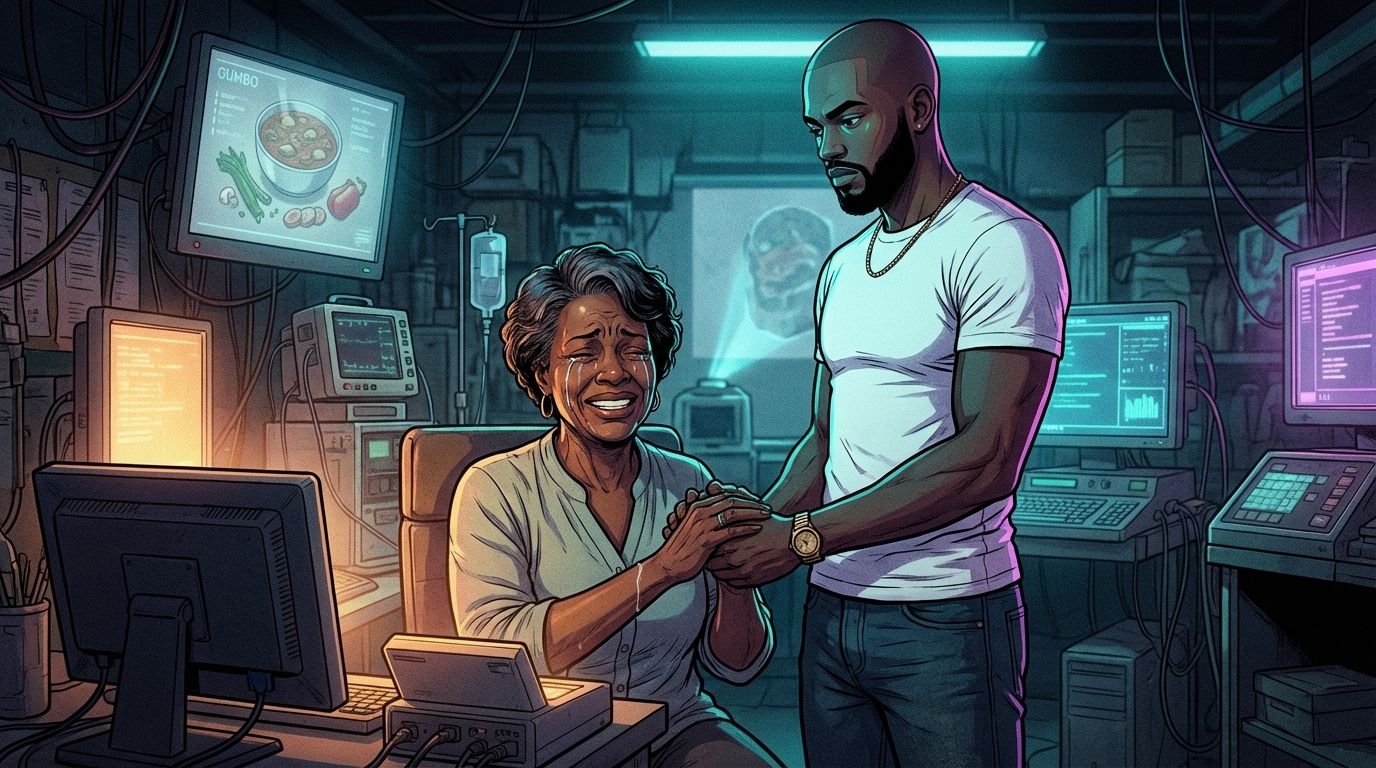
The first install was a woman named Denise. Fifty-three years old, retired schoolteacher, lived alone in a shotgun house not much different from the one I grew up in.
She wanted to remember her mother’s gumbo.
“She’s been gone eleven years,” Denise told us, sitting in Marcus’s chair, hands trembling. “I’ve tried to make it myself. Every recipe, every variation. It’s never right. Something’s always missing, and I can’t figure out what.”
Her mother had died with Alzheimer’s. The recipe was lost. The taste was lost. The specific Saturday afternoon when Denise was twelve years old, standing in her mother’s kitchen, learning the secrets that would never be passed down.
Marcus found a woman named Cora. Seventy-one, lived in Sunnyside, had grown up three streets from Denise’s mother. Cora’s grandmother had made the same gumbo—probably learned from the same source, generations back. Same roux. Same trinity. Same slow simmer that turned ingredients into love.
Cora agreed to let us copy the memory. She didn’t fully understand the technology—none of us did, really—but she understood what we were trying to do.
“Some things shouldn’t be forgotten,” she said. “If I can give that to someone, that’s a gift.”
The transfer took eleven minutes. Marcus monitored the readouts while I held Denise’s hand. She’d gone quiet when the process started—not unconscious, just somewhere else. Her eyes moved behind closed lids like she was dreaming.
When it was over, she sat up slowly. Disoriented. Blinking.
“How do you feel?” Marcus asked.
Denise didn’t answer. She was crying. Silently, steadily, tears running down her face while her expression shifted from confusion to wonder to grief to joy, cycling through faster than I could track.
“I can taste it,” she whispered. “Oh my God. I can taste it.”
She went home and made gumbo that night. Called us three hours later, sobbing, saying it was perfect. It was right. For the first time in eleven years, she’d brought her mother back.
We charged her fifty dollars. Marcus wanted to do it for free, but I convinced him that people don’t value what they don’t pay for. And we needed the money to keep going.
Fifty dollars. The most meaningful transaction of my life.
Word spread the way word spreads in the Fifth Ward.
Church parking lots and barbershop debates. Cousins who knew cousins. The woman at the laundromat who heard about Denise’s gumbo and wanted to know if we could help her remember her son’s voice—he’d died in Afghanistan, and she was forgetting the specific way he said “Mama.”
We helped her. We helped the next one too. And the next.
Within three months, we had more demand than we could handle. Marcus built devices as fast as he could, training himself on soldering techniques from YouTube videos, sourcing parts from the Medical Center’s shadow economy—the tunnels underneath the hospitals where orderlies sold “damaged” equipment that worked fine.
I handled everything else. Finding clients. Vetting them. Setting up installs in locations that wouldn’t attract attention. Building a network of people who could spread the word without spreading it too far.
The product evolved based on what people wanted.
The Grief Pause — $200
You’ve just lost someone. The wound is fresh. You can’t function—can’t work, can’t parent, can’t exist—but the world doesn’t stop for grief. It keeps demanding, and you can’t meet the demand.
For two hundred dollars, we could install a buffer. Not erasure—we weren’t monsters. Just a delay in the emotional processing. You’d still know your mother had died. You’d still need to grieve eventually. But you could get through the funeral without collapsing. Finish the project at work. Make it through the holidays.
Grieve on your schedule instead of drowning on theirs.
The Confidence Boost — $200
This one was Marcus’s innovation. He figured out that memories weren’t just what happened—they were how it felt to do something. Procedural memory, he called it. The muscle memory of competence.
We could install the experience of being good at something. Not the skill itself—you couldn’t suddenly play piano because you remembered performing at Carnegie Hall. But you could remember the feeling of success. The calm certainty that you belonged somewhere, that you could handle what was coming.
The Ozempic Companion — $50
Houston was ground zero for the weight-loss drug revolution. Half the city was on semaglutide, dropping pounds and discovering a problem nobody had anticipated: they missed food.
For fifty dollars, we could give them that experience without the calories. The char on a Pappas Bros ribeye. The grease dripping from a Whataburger patty melt at 2 AM. The specific transcendence of a Shipley’s kolache when you’re hungover and desperate.
All the dopamine, none of the weight.
Trap was the one who suggested the slabs.
Trap was fifty-seven years old, ran a garage off Lockwood, and had been building custom cars since before I was born. His real name was Arthur, but nobody had called him that in forty years. He was Trap because he trapped beauty in metal and paint—took ordinary vehicles and turned them into rolling sculptures.
“You know why we ride slabs?” he asked me one night, polishing his trunk setup like it was an altar.
I said something about style. Houston culture. The tradition.
“Nah.” He shook his head. “We ride slabs because they can’t take them from us. The city took our neighborhoods. Developers took our houses. Government took our votes. But they can’t take a car. A car moves. A car is yours as long as you can drive it.”
He looked at me with eyes that had seen too much to be impressed by anything.
“Your memory thing. You could put that in a trunk setup. Make the car into something more than transportation. Make it a time machine.”
Houston Memory Rides — $150-1,000
The concept was simple: you’d ride through the city while experiencing someone else’s memory of what that city used to be. The GPS would sync with the installation, so when you drove past a specific intersection, you’d see it as it existed in 1996. Or 1985. Or whenever the memory was from.
We partnered with old-timers who remembered the neighborhoods before the changes. Miss Addie, who’d lived in Fifth Ward her whole life, became our primary source. Her memories were gold—sharp, vivid, emotionally rich. Through her, you could cruise down Lyons Avenue and see the corner stores that had become Starbucks. Hear the music that now got noise complaints. Feel the density of community that had been demolished for freeway expansion.
“You think you invented something new,” Miss Addie said, sitting on my mother’s porch while the sun went down. She was seventy-three years old, moved slowly but thought fast, and had known my family since before I was born.
“You didn’t.”
I waited. Miss Addie delivered wisdom on her own schedule.
“In 1972, they bulldozed the church I was married in. Built Highway 59 right through our neighborhood. Said it was progress. Said we’d adjust.” She looked at me with eyes that had watched the city transform into something unrecognizable six times over. “They’ve always been erasing us, Kale. You just gave them a faster tool.”
“I’m preserving—”
“You’re packaging. Different thing.” She held up a hand before I could argue. “I’m not saying it’s wrong. I’m saying be careful about what you think you’re doing.”
“What do you mean?”
“Those memories you’re selling. The ones from the old neighborhood. People experience them, they feel something. They think they understand. But understanding isn’t living. A memory of a place isn’t the same as fighting to keep that place alive.”
She was quiet for a moment. A car rolled by, bass thumping, swangas catching the last light.
“What happens when the memory is all that’s left? When you can get Fifth Ward in a download without ever meeting a person who lived there?”
I didn’t have an answer.
“You’re building a museum, baby. And you know what happens in museums?”
“What?”
“Things die. They just die pretty.”