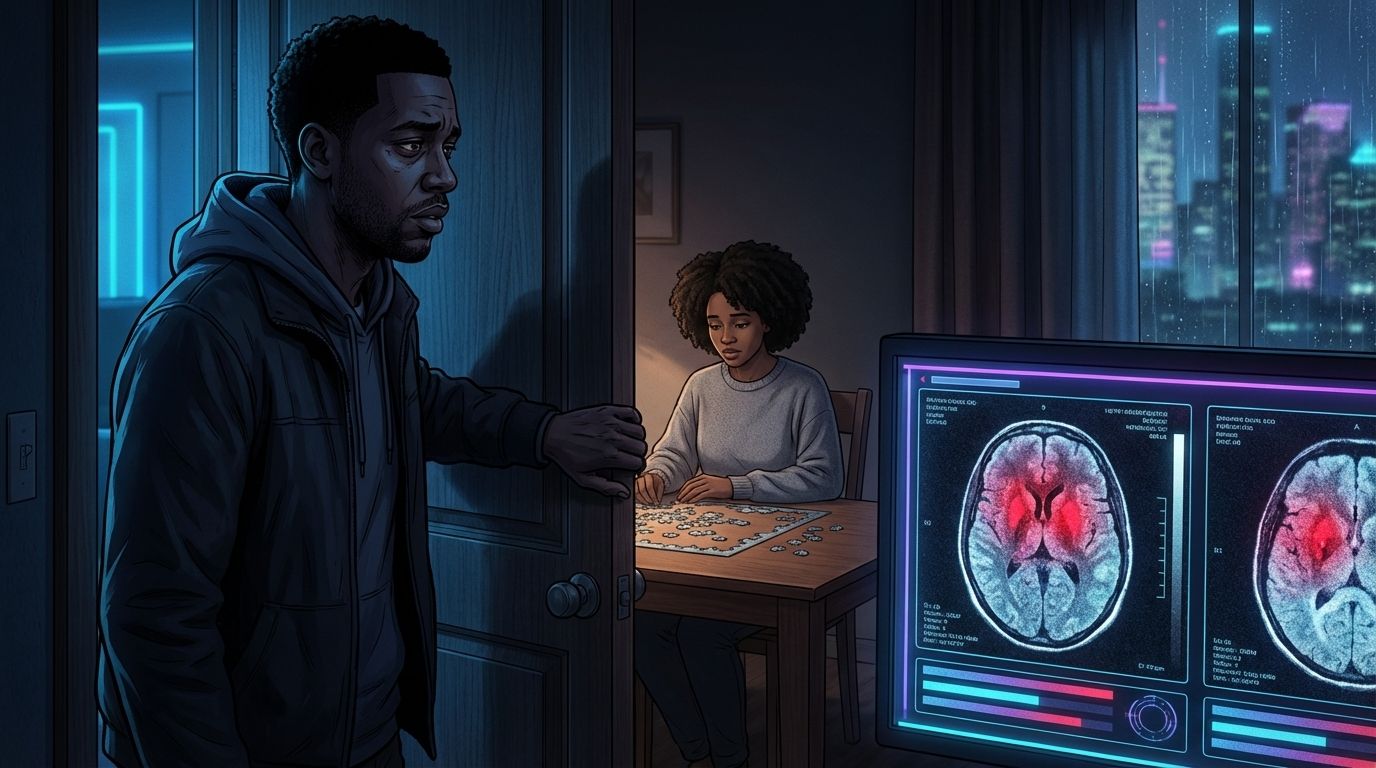
Marcus’s sister was fading.
I’d met her twice—once when she was still mostly herself, once when she’d started to slip. The first time, she’d looked at me with sharp, curious eyes and asked how I knew her brother. The second time, she’d looked at me with those same eyes and asked who I was.
The car accident had damaged her hippocampus. Memory formation was compromised. She could retain new experiences for a few hours, sometimes a few days, but eventually they slipped away like water through fingers.
Marcus had built Echo to save her. That was the original purpose—not commerce, not revolution, just a brother trying to preserve his sister before she disappeared entirely.
But the technology that could install memories couldn’t repair the mechanism that held them. He could give her experiences; he couldn’t make them stay.
And now, after two years of experimental treatments, the damage was spreading.
“She used to remember our childhood,” Marcus told me. “Even after the accident, she had everything from before. Now she’s losing that too.”
We were in his lab. The screens showed brain scans—Lena’s brain, mapped in terrifying detail. Red zones where activity had declined. Grey zones where function had ceased entirely.
“I can install new memories,” Marcus said. “But they don’t integrate anymore. They just sit there, disconnected, like files in a folder she can’t find. She knows something is there, but she can’t access it.”
“What about the source memories? From before?”
“Degrading. The architecture is collapsing. It’s like—” He struggled for a metaphor. “Like a hard drive that’s physically failing. You can add new files, but the disc itself is dying.”
“How long?”
“Months. Maybe a year.” He looked at me. “Unless I figure something out.”
I watched him turn back to his screens. The man who’d invented the most powerful technology of our generation, helpless against the simplest problem: time.
“I’m working on something,” he said. “Something new. But I don’t know if I can finish it before—”
He stopped. Couldn’t say the words.
I left him there, surrounded by equations that might save his sister or might just document her decline. There was nothing I could do. Nothing anyone could do.
Some things can’t be fixed. Some damage is too deep. Some losses are permanent even for people who are supposed to be able to fix anything.
But I didn’t understand that yet. Not really. I was still young enough to believe that enough power could solve anything.
I’d learn.