The call came from Dom.
Six months after our first meeting. I hadn’t spoken to him since that day in the garage, had done everything I could to stay out of his orbit while competing with his product.
“Mr. Booker.” His voice was smooth as ever. “I have a business proposition.”
“I told you. We’re not interested in partnerships.”
“This isn’t a partnership. This is a transaction. One time. Mutually beneficial.”
I should have hung up. Should have ended the call and blocked the number and never thought about it again.
“I’m listening,” I said.
The cop had killed a kid.
Sixteen years old. Jaylen Williams. Pulled over for a broken taillight on a Wednesday evening. The bodycam footage was unambiguous: Jaylen reached for his registration, and Officer Thomas Barrett fired seven times.
Barrett claimed he’d seen a weapon. There was no weapon. There were seven bullet wounds in a teenager who’d been trying to follow instructions.
The trial was scheduled for June. The city was holding its breath. Justice Department was watching. Media was camped outside the courthouse.
And Dom had contracts with the DA’s office.
“Jury optimization,” he called it. The same technology we’d built for therapy and nostalgia, weaponized for conviction. Potential jurors would be screened for susceptibility, approached for “civic research studies,” and given memory installations that shaped their perception of the case.
Not bribery. Something worse. Belief modification. Making them certain of conclusions they hadn’t reached on their own.
“The prosecution wants this one,” Dom said. “Conviction. Full sentence. A message to every cop in America that there are consequences.”
“Then why do you need me?”
“Because the installation is delicate. The jurors need to believe they’re reaching their own conclusions. That requires finesse. Your team’s work is—” He paused. “—artful. Subtle. The kind of quality that doesn’t feel like quality.”
“You want me to install memories that convict a cop.”
“I want you to install memories that produce justice.” His voice hardened. “You’ve seen the video. You know what happened. Barrett murdered that kid, and without intervention, a Harris County jury is going to find reasonable doubt because that’s what Harris County juries do. I’m offering you the chance to make sure that doesn’t happen.”
I thought about Jaylen Williams. Sixteen years old. Reaching for his registration.
I thought about the system. The way it worked. The way it had always worked. Conviction rates for Black defendants thirty-seven percent higher than for white defendants with identical charges. Public defenders with seven minutes per case. Judges taking campaign contributions from private prison companies.
The system was already rigged. Dom was just rigging it in a different direction.
“What do you want from me?”
“Your presence. Your expertise. And your silence.” A pause. “In exchange, I’ll share something you’ve been looking for. Information about a pilot program in San Antonio, five years ago. Something to do with a city councilwoman.”
Sienna’s mother. The woman who’d forgotten her own daughter.
“You have information about that?”
“I have everything about that.” Dom’s voice was soft. Almost kind. “Help me with this, and it’s yours. Every document. Every name. The whole truth.”
The whole truth. About what they’d done to Sienna’s mother. About the people responsible.
I could give that to her. Could give her the answers she’d been hunting for years.
All I had to do was help convict a murderer.
I told myself it wasn’t wrong.
The cop was guilty. Everyone knew it. The video was unambiguous. The only question was whether a rigged system would let him walk.
All we were doing was un-rigging it. Balancing scales that had been tilted for decades. Making sure that, for once, justice looked like justice.
That’s what I told myself.
The installation happened in a nondescript office building near the Galleria. Twelve jurors, carefully screened. They thought they were participating in a focus group about community safety.
I did the work myself. Dom wanted quality, and quality meant hands-on attention.
The memory I installed wasn’t complicated. Just a shift in perspective. The ability to see Jaylen Williams as a child, not a threat. The ability to see Officer Barrett’s fear as cowardice, not instinct. The emotional certainty that seven bullets were not reasonable force.
The jurors walked out believing they’d spent an hour discussing neighborhood policing. They didn’t know anything had changed.
But something had changed. In them. In me.
The trial lasted six days.
I watched from the gallery. Told Sienna I was meeting a supplier, told Marcus I was scouting expansion locations. Sat in the back row and watched the prosecution present the bodycam footage, the forensics, the character witnesses.
The defense was good. Better than I’d expected. They found inconsistencies in the timeline. Questioned the ballistics. Put Barrett on the stand, where he cried about the split-second decisions that officers have to make.
But the jury wasn’t listening. Not really. They were nodding at the right moments, frowning at the right moments, performing deliberation. But I could see it in their eyes: they’d already decided.
I’d made sure of it.
The verdict came on the seventh day. The foreman stood. The judge asked for the finding.
“We find the defendant—”
I watched Barrett’s face. The hope draining out of it.
“—not guilty.”
The courtroom erupted. But I didn’t hear it. I was staring at the foreman, trying to understand.
Not guilty. The jury I’d installed had voted not guilty.
Dom’s voice in my ear, from a call the night before: “There’s been a change in the client’s requirements. The conviction is no longer desirable.”
I hadn’t understood. Had thought it was a test, or a miscommunication, or something I’d misheard.
But I understood now.
I’d installed the wrong memory. Not the one I’d designed—the one Dom had substituted. While I’d been focused on the technique, on the quality, he’d switched the payload.
The jurors didn’t see Jaylen as a child. They saw him as a threat. They didn’t see Barrett as a coward. They saw him as a hero, making an impossible choice.
I’d convicted a murderer. And then I’d acquitted him.
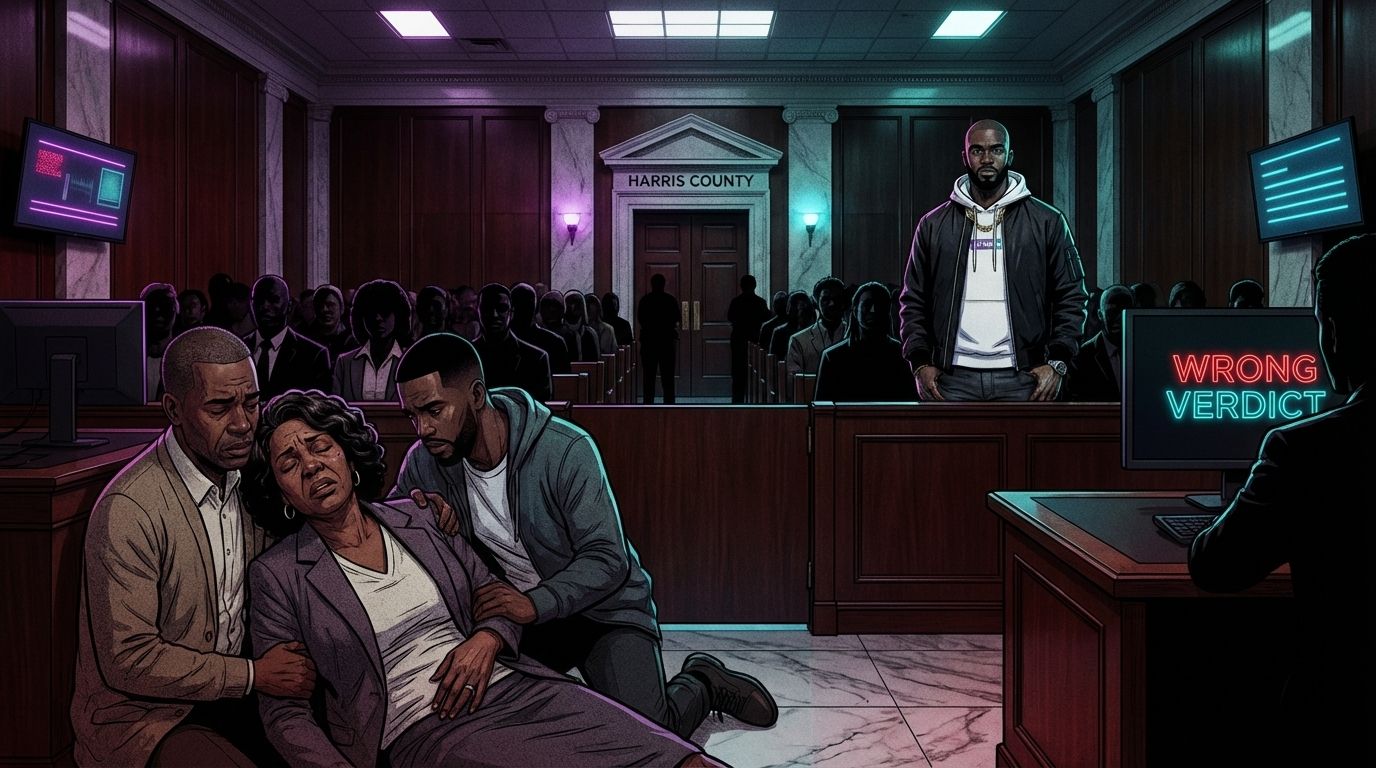
In the gallery, Jaylen’s mother was collapsing. Her screams echoed off the marble. Her family tried to hold her up, but she’d gone boneless with grief.
I watched. And I understood, finally, what I’d become.
My technology. My hands. My choice to participate.
I’d built the gun. Dom had pulled the trigger.
And the bullet had gone exactly where he’d intended all along.