Marcus found me at the slab shop three days later.
I hadn’t been home. Hadn’t called Sienna. Had been sitting in Trap’s garage, drinking and not talking, trying to figure out how to undo something that couldn’t be undone.
“I saw the news.” Marcus stood in the doorway. “The Barrett verdict.”
I didn’t respond.
“People are saying the jury was compromised. That something was wrong with their deliberation. They’re calling for an investigation.”
“Good.”
“Kale.” He stepped inside. “What did you do?”
I told him. All of it. Dom’s offer. The installation. The switch. The moment I understood that I’d been used to destroy exactly what I’d thought I was protecting.
Marcus listened without interrupting. When I finished, he was quiet for a long time.
“You did it for Sienna,” he said finally. “The information about her mother.”
“That’s not—”
“Don’t.” His voice was sharp. “Don’t pretend it was about justice. You did it for her. Because you thought you could give her something she needed.”
He was right. I’d told myself it was about the verdict, about fixing a broken system. But Dom had known better. He’d dangled exactly the right bait—answers for the woman I loved—and I’d swallowed it whole.
“Did he give you the information?”
I pulled out the envelope. Dom had sent it the morning after the verdict. Hundreds of pages documenting the San Antonio pilot program—names, dates, procedures, authorization chains. Everything Sienna needed to understand what had been done to her mother and who was responsible.
“Are you going to give it to her?”
I looked at the envelope. At the truth it contained.
“I don’t know.”
Sienna found out on her own.
She was an investigative journalist. She had sources I didn’t know about, contacts in places I couldn’t reach. And she’d been tracking the jury manipulation program for months—following the money, the paperwork, the patterns.
Three weeks after the verdict, she walked into my apartment and placed a folder on the table.
“I know what you did.”
I looked at the folder. Didn’t open it. Didn’t need to.
“Sienna—”
“Don’t.” She held up a hand. “Don’t explain. Don’t justify. Don’t tell me you had reasons or it was complicated or you were trying to help.”
She was shaking. I’d never seen her shake before.
“I spent six months watching you. Filming you. Telling myself you were different. That what you’d built was something good, something that mattered.” Her voice cracked. “I defended you. To my colleagues, to my sources, to myself. I said you were one of the good ones.”
“I was trying to—”
“To what? To help me?” She laughed. Bitter. Broken. “Did Dom offer you information about my mother? Is that what this was?”
I couldn’t lie to her. Not anymore.
“Yes.”
The word hung there. A grenade with the pin pulled.
“You tampered with a jury. You helped a murderer walk free. Because you thought you could buy me answers.” She was crying now. Silently, furiously. “You made my mother’s tragedy into your transaction. You used what was done to her as—as currency.”
“I didn’t know Dom would switch the payload. I thought—”
“You thought you could do something unforgivable and have it come out clean. Because your intentions were good. Because you loved me.” She wiped her eyes. “That’s not how it works, Kale. That’s never how it works.”
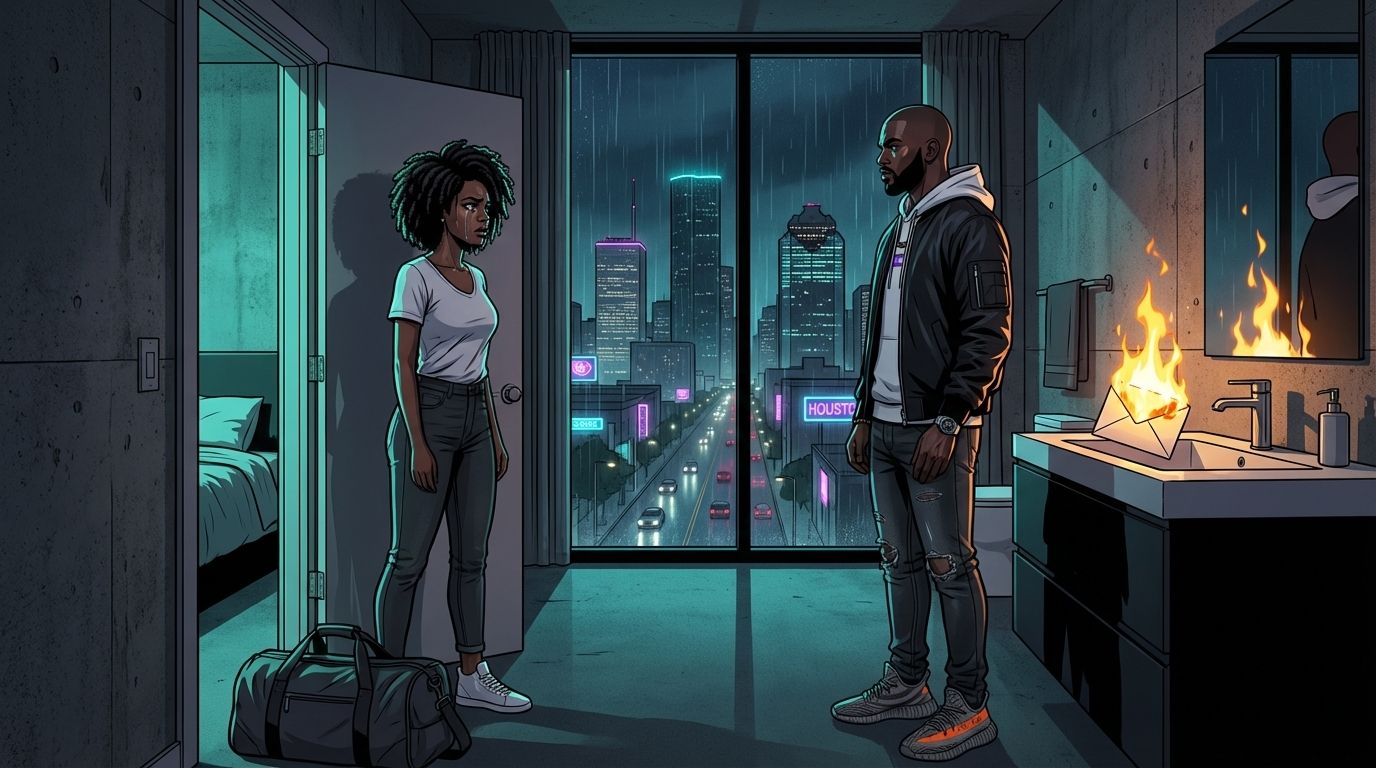
She picked up her bag. The same bag she’d carried the first time she walked into Trap’s garage, full of cameras and questions and a determination I’d admired from the first moment.
“The documentary releases next week. Everything I found. The jury program, the installations, the whole network.” She looked at me. “Your name is in it. Your face. Everything.”
“I know.”
“I’m not protecting you.”
“I know.”
She walked to the door. Stopped.
“I thought you were different,” she said. Quietly. Like a door closing.
“I know,” I said. “I thought so too.”
She left.
I sat there for a long time. Holding the envelope Dom had sent—the information about her mother that had cost me everything to acquire.
Then I walked to the sink and burned it.
Some answers aren’t worth what you pay for them.