Sienna’s documentary dropped on a Tuesday.
By Wednesday morning, the operation was over.
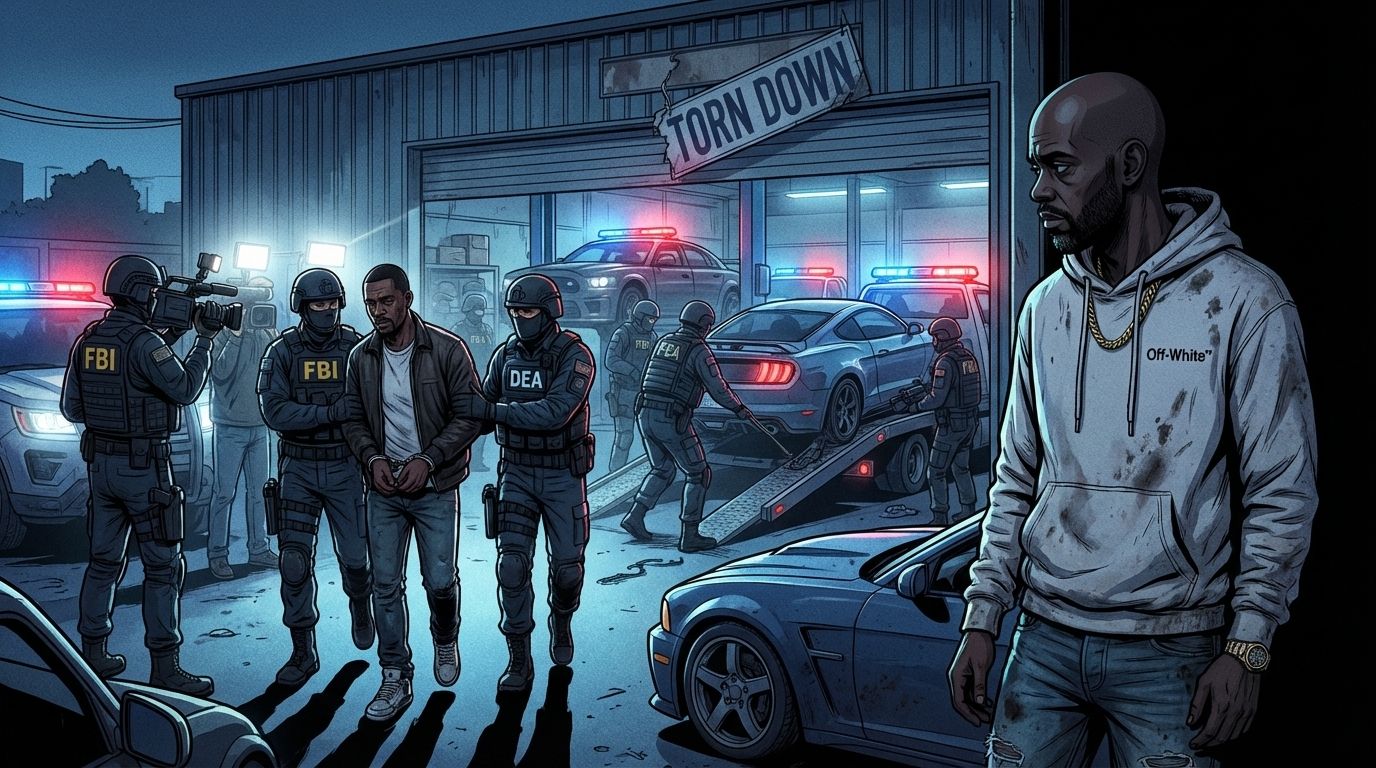
Feds showed up at the slab shop at 6 AM—twelve agents in tactical gear, as if Marcus’s soldering equipment might shoot back. They seized everything: devices, computers, customer records, the prototypes we hadn’t finished testing. Trap’s garage got red-tagged, his slabs impounded as “potential evidence.”
Marcus was arrested at his lab. They led him out in handcuffs while the news cameras Sienna had tipped off recorded everything. I watched the footage on my phone from a motel room in Baytown, where I’d gone to ground the night before.
The documentary was thorough. Devastating. Sienna had traced the supply chains, the money, the connections between our operation and Dom’s darker work. She hadn’t been able to prove the jury tampering directly—the evidence was too carefully hidden—but she’d painted a picture that made the implication clear.
The Memory Broker: How Houston’s Underground Memory Trade Enabled a System of Control.
My face was on every news channel in Texas. My name was in federal complaints. The empire I’d built in three years disintegrated in three days.
And Dom walked away clean.
His connections ran deeper than mine. His lawyers were better. The same system that was coming for me protected him—the kind of protection you buy with campaign contributions and political access and the knowledge of where bodies are buried.
He called me once, the day after the arrests.
“I warned you,” he said. “Everything has a price. You just didn’t understand what you were selling.”
“What do you want?”
“Nothing. I have everything I need.” A pause. “But I wanted you to know: this isn’t personal. You were useful until you weren’t. That’s just business.”
“You destroyed—”
“I optimized. You were a competitor, and now you’re not. The market will recover. The technology will continue. The only thing that changed is that you won’t be part of it.”
He hung up. I threw the phone against the wall.
It didn’t help.
The Blankers were everywhere now.
Dom’s knockoffs had flooded the market so completely that even after the crackdown, the damage kept spreading. People who’d bought cheap installations months ago were degrading, their memories corrupting, their personalities fragmenting under the weight of poorly integrated experiences.
I saw them on the streets when I moved between safe houses. Standing on corners with empty eyes. Walking in circles with no destination. Bodies that had lost the minds inside them.
Some of them had been our clients. I recognized faces from the early days—the man who’d wanted confidence for a job interview, the woman who’d wanted to remember her grandmother’s cooking. They’d come to us for help, and somewhere down the line, they’d ended up in Dom’s pipeline instead.
I couldn’t prove we were responsible. Couldn’t prove we weren’t. The technology was ours. The market was ours. The consequences belonged to everyone and no one.
Trap found me at a dive bar off the Ship Channel, three weeks after the collapse.
“You look like hell,” he said.
“I feel worse.”
He sat down across from me. Same Trap—unhurried, thoughtful, measuring his words like ingredients in a recipe.
“I’m not here to lecture you. You’ve done enough of that to yourself.”
“Then why?”
“Because I found something.” He pulled out his phone, showed me a photo. A woman standing on a corner off Lockwood. Empty eyes. Vacant expression. A Blanker.
“That’s Miss Addie.”
The floor dropped out from under me.
“She was trying to help people. Going around to folks who’d bought the knockoffs, trying to warn them. Someone must have decided she was bad for business.”
I stared at the photo. Miss Addie. Seventy-three years old. The woman who’d known my family since before I was born. Who’d warned me about building museums. Who’d provided the memories that let people visit a Houston that didn’t exist anymore.
Gone. Her body still walking around, but everything that made her her—erased.
“Who did it?”
“Does it matter?” Trap’s voice was gentle. “She’s gone, Kale. Same as all the others. Same as—”
He stopped.
“Same as who?”
Trap was quiet for a long moment. Then he pulled out another photo.
A man standing in front of a warehouse. Uniform shirt. Broom in hand. Eyes empty.
Me. It was me in that uniform shirt. The same clothes I’d seen—
“That’s Jerome,” I said. “From the party. The first one who glitched.”
Trap nodded. “He got worse. Went looking for help. Found the wrong people.”
Jerome. Who’d come to us wanting to remember his grandmother’s voice. Who’d trusted us with the most delicate part of himself. Now he was sweeping floors somewhere, an empty vessel being used for labor.
“There’s more.” Trap’s voice was heavy. “A lot more. People from the early days. People who trusted us.”
I couldn’t look at the photos. Couldn’t face the evidence of what we’d built.
“What am I supposed to do?”
“I don’t know.” Trap put his phone away. “But I know you can’t run forever. Whatever’s coming—you have to face it.”